Fiction and Non-fiction Travel and Food Writer

Category: Savoring the Olde Ways (Page 9 of 10)

Spanish Traditional Cooking Class – Barcelona

Spanish Traditional Cooking Class – Barcelona Cooking School

            Sweat poured down my cheeks, onto my neck and dripped down into my bra.  It was another extremely hot morning in Barcelona—July 4th to be exact—and one of the few days of this summer’s epic heat wave of Europe 2019.  Because I write about traditional cooking in my new culinary travel series, Savoring the Olde Ways, my husband and I were on a mission—to find the location of one special Spanish traditional cooking class known as, Just Royal BCN.  As noted in their brochures, it was to be a ‘gastronomic space, which for its idiosyncrasy and location in the heart of Barcelona at the Plaça Reial, was ideal.”   Whatever the “ideal” was meant to be, we had no idea, but at least we had found the Plaça Reial, which was the local plaza, where the cooking school was to be located.
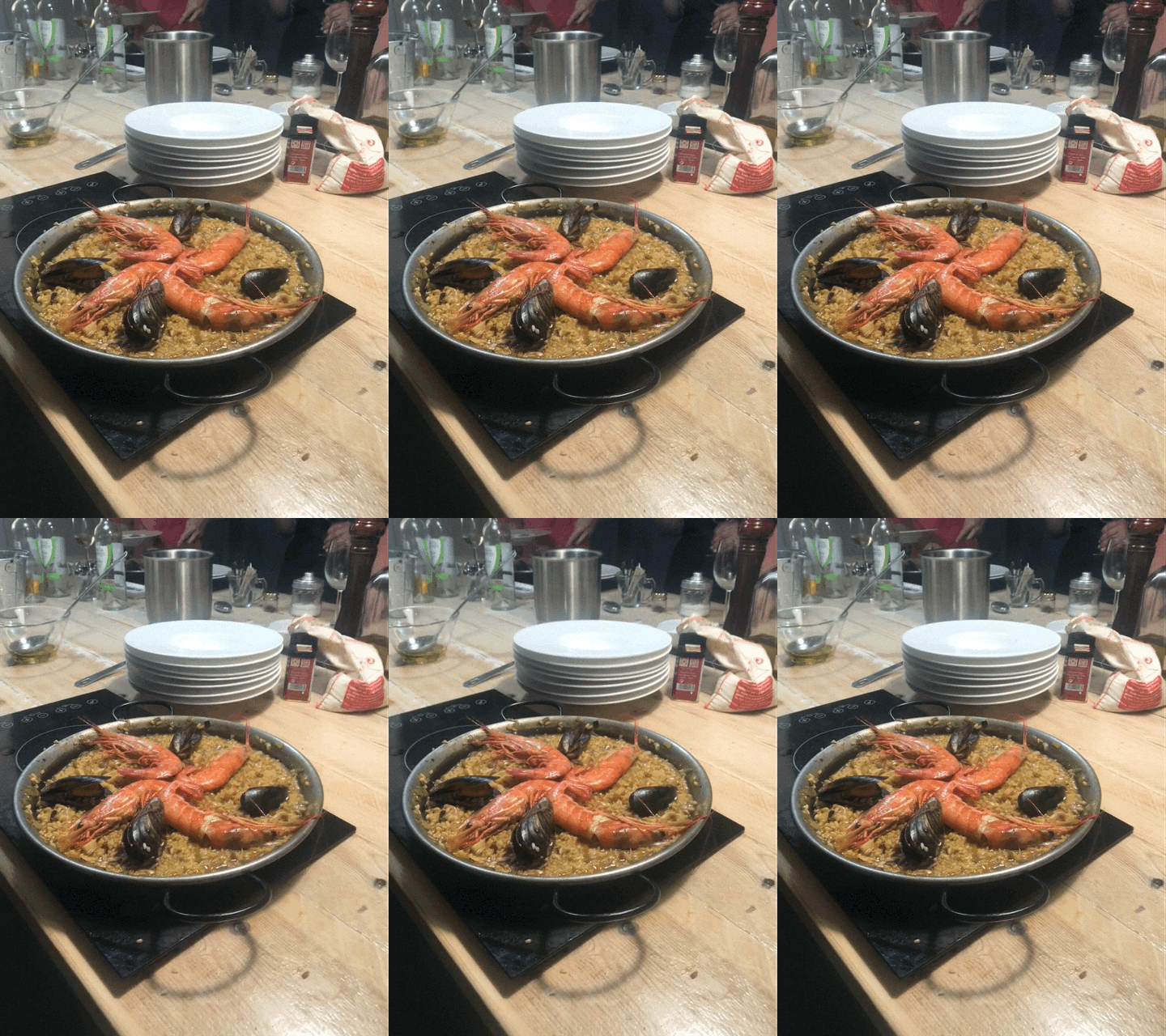
Traditional Spanish Paella

            Slogging across the Rambla, a main thoroughfare in old
Barcelona, skittering past motor scooters and an onslaught of cars, dodging
between pedestrians and avoiding the collapse and spillage of a full cart of canned
beer onto the sidewalk, we made our way into a courtyard.  As luck would have it, it was in yet another
courtyard where we found the door, rang the buzzer, and were allowed to ascend
to the third-floor apartment— (which in Europe, of course, is the fourth
floor).  Oh, my! No elevator here!  Four floors of winding uneven steps on both
wood and stone in a darkened stairwell, we wound up, up, up, until we were finally
swept into a veritable blast of air-conditioned wonder.  As we headed to the nearest sofa to collapse,
our cheerful host and cooking instructor, Teresa, thrust a couple of glasses of
water into our hands.  Saved!

            Surprisingly, we were early, and I had a moment to look
around the brightly lit, modern and nicely appointed rooms.  Black and white tile floors swept through the
dining room (already formally set for ten) and sitting room with a white fireplace
(not needed right now).  Vases with arrangements
of driftwood and green plants. Chrome and white chairs, sofa and bar stools composed
the sitting area.  And separating the
modern cooking station with seating for ten was an ornate Moorish-style room
divider. Classy!

            Within moments of our arrival, other stalwart sorts lumbered
into the room, grabbed glasses of water, and before introductions could even be
made, we were rushed out the door and back down those same dark steps—did I
mention the darkness before?—and into the furnace of the day.  We were off to the Farmer’s Market, which was
only a few short blocks away and right off the Rambla. 

            Now, I must tell you, I absolutely love the colorful
array at a farmers’ market.  The displays
and tables are piled high with the most luscious and lasciviously arranged red,
purple and blue fruits, melons and berries. 
Piles of pink shellfish with silver and black freshly caught seafood
were cradled in troughs of ice.  Ah, but,
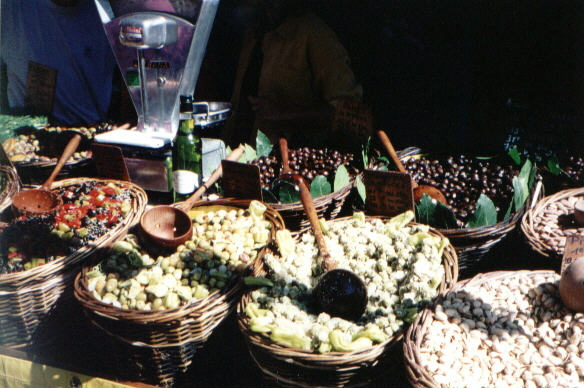
assortments of fresh local cheeses, olives, Iberian ham and salami slices were held
in second place to the famous acorn-fed Jamón Ibérico de Bellota (black
hams) which were hanging on hooks wearing personalized black zip-off
coats.  (Oh, this could set one back a whole
month’s salary.)  Plus, there were
displays of fresh pastries, almond candy nougat, saffron and more spices in
abundance.  (Oh, but no black pepper and
I’ll tell you about that later.)  My
senses were on overwhelm on this magical whirlwind tour. No, we were not given
time to purchase anything, yet I had discovered a treasure trove of edible
delights and was in my glory.

            Teresa introduced us to her favorite purveyors, we bought
only fresh tomatoes, took another quick look over our shoulders, and hurried
back down the boulevard.  (She had
shopped earlier that morning—6 a.m., I believe—for all the fresh seafood we
would be preparing in the many different recipes she had in mind for us.)  Back up those lengthy steps we went, and
before settling into our seats at the demonstration table, glasses of water were
once again administered–and, oh, white wine was also served.  Okay now, we were ready.

            We donned our black aprons and leaned in close as Teresa
began teaching us some of the finer points of Spanish cuisine.  “Some of you might consider Spanish food to
be spicy,” she began, “but that is not the case. We love our food, but we do
not love spicy food. So, if you find a black pepper shaker on a table in a
restaurant, please know that it is only for you tourists.  We never touch the stuff!” she said with a
lift of her chin.  And, then she
smiled.  We were already eating out of
her hand and . . . oh first we started with the preparation of tortilla de patatas, of which
we needed to cut the onions, potatoes, break a few eggs, and boil the potatoes
in two cups of olive oil. 

            “Two cups?” we wailed. 

            “Oh, my yes.  But
we always reuse our olive oil. It is perfectly good for a number of days after
its first use if stored well.” 

            We were dumbfounded. 
Who knew?  I buy my olive oil through
an olive oil club, which is much like a wine club, but not quite, and the price
of a few precious ounces can give one pause for overuse.  It was obvious I had much to learn.  And, we still hadn’t started on the paella!

           In the course of three hours more, with plenty of ‘cooking’ wine to sustain us, we were able to participate in the creation of the Tortilla Patata, which is a potato omelet; Pescaito Frito (small fried fish); Catalan Cream (Spanish crème brulée); Spanish grilled jumbo shrimp; and—ta da!—seafood-filled Paella (with mussels, clams, calamari, squid, and jumbo shrimp, oh my!).  Definitely the freshest tasting and best paella I’ve ever encountered!  Well, you had to be there!  And, you could be, if you just contact the folks at Just Royal BCN the next time you are in Barcelona.  It was certainly an experience of a lifetime and one more peek inside another exciting culinary culture.  Olé!  Olé!

Carole
Bumpus

www.carolebumpus.com Snap Herplex Hub
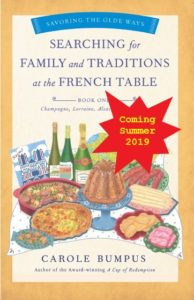
A Peek at the Prologue to Upcoming book, Savoring the Olde Ways – by Carole Bumpus

Have you ever strolled down a cobblestone street in a foreign village, passed an open window, and heard laughter flowing out to greet you?  Did you stop to listen to the banter and wonder what it would have been like to live there?  In that house?  That village?  And oooooh—what was that wonderful aroma?  What could they possibly be preparing for dinner?
My upcoming book series, Savoring the Olde Ways, due to be launched August 27, 2019, is a compilation of stories and traditional recipes I had the good fortune to gather during interviews and conversations with families as I traveled throughout France and Italy. Part culinary memoir and part travelogue, these books present the personal experiences of three generations of families, as told to me inside their homes, along those very streets.

The first book of my series is called, Searching for Family and Traditions at the French Table, Book One.  It is the first half of a culinary adventure I took with my dear French friend, Josiane Selvage, from Paris in the Île-de-France, through the Champagne, Alsatian and Lorraine Regions before returning to Paris.  The second book, Searching for Family and Traditions at the French Table, Book Two will be the completion of this adventure beginning in Paris, and heading north into Pas-de-Calais, Normandy, Brittany, Loire and completing the tour in the Auvergne.  The scheduled launch date for this second book is August 2020.  The third book moves into Italy and is called, Searching for Family and Traditions at the Italian Table, Book One.  This one will arrive in April 2021.  Oh, yes, and there is so much more to come–from both countries.  Come join me as we sip and sup throughout these culinary travel experiences! Snap Herplex Hub

I was born on November 11, 1918, Armistice Day, the last day of World War I

(A revised excerpt from A Cup of Redemption, an historical novel) 

“When were you born?” I asked Marcelle Zabé, my 83-year-old French guest.  My question must have floated out of the blue, but Marcelle immediately put her coffee cup down on the table and sat forward.  The deep lines in her face smoothed as her rich voice lifted.

“I came into the world with a bang!” Marcelle Zabé resounded. “Gunshots, shouts of wild rejoicing, cries of joy and great jubilation echoed through the streets of my hometown, Vannes in Brittany,” she said, as her hands took flight.  A new sparkle danced through her eyes.

Music played in the streets for the first time in four years. People danced, sang, hugged and cried. It was quite a wild affair, I was told. Not just for my birth, of course,” she laughed, “and, not just for Brittany, but for all of France. I was born on November 11, 1918…Armistice Day, the last day of World War I.” Her voice held a triumphant lilt.

She stopped talking for a moment, picked up her fork and stabbed a morsel of lemon tart.  Popping it into her mouth, her eyes rolled, and she swooned.  I was pleased that she approved of my meager culinary talents.  Then, Marcelle continued her story. 

I had been interviewing Marcelle, along with her adult daughter, Josiane, about French foods, recipes and family stories in the comfort of my own kitchen.  As a retired family therapist, I had been relaxing into the idea of gathering stories for a book I was thinking of writing.  It could be more like a cookbook with family anecdotes, I remember considering.

“My Grand’mère often told me the celebration was just for me,” Marcelle continued.  “Why, they even thought of naming me ‘Victory.’”  She laughed again at the old family tale which rolled off her tongue as being oh, so familiar.

“Grand’mère used to tell me many things about that time, as she was the one who raised me.”  Marcelle closed her eyes for a moment as she reflected back over her more than eighty years.

“What did people do during the Great War, Grand’mère?’ I used to ask her. I must have been seven years old when we first started this game. ‘Well, ma Cherie, it was a difficult time,’ she would respond. ‘The men who marched off as soldiers in November 1914 expected to return home in time to eat their Christmas goose. Everyone was surprised when the war lasted four very long years. No men were left to handle the fishing boats,’ she would say, waving her hand in the direction of the nearby sea, ‘and, no men were around to bring in the few crops which grew. War was not a time for choice, Marcelle; only a time for survival.’

“‘So, what happened after the War?’ Marcelle said as she continued to recount her grandmother’s words, “and always I received the same response, ‘The losses of men left mothers, fathers, young wives…all weeping in the still of the night or filing into the Church to pray to their saints. Your mother was among them, you know. Many a day, the only sound to be heard was the chink…chink…chink…of the masons chiseling the names of those who died into stone on the village war memorial.’

“‘Was my father’s name among them?’ I would ask her.”  Marcelle stopped short, she turned to me, and said, “But no answer ever came my way.”  Her eyes dropped to her now-empty coffee cup.

My head instantly snapped to the side to catch her daughter’s reaction, as Josiane had been quietly translating her mother’s every word.  I know my eyes must have been boring into her to prompt her to give me some clue.  Where should I go from here?  As a therapist, I knew the importance of her mother’s statement and this was huge!  I didn’t want to pry, but I also didn’t want to blithely continue a simple interview about French food and families if this was uncomfortable.  Josiane continued to stare into her own cup.  After a moment, she looked up at me and shrugged.

* * * * * * * * *

Marcelle Zabé was born 100 years ago today – November 11, 2018 – into a world celebrating the end of the Great War.  But what Marcelle was forced to contend with during her entire 84 years of life was the lasting burden of war.  She carried the last name of a father she never met—knew nothing about.  Had he died during that cataclysmic war or just failed to return home?  Were her parents even married?  Any conversation on this subject was always swathed into silence.  Abandoned, too, by her mother due to economic circumstances, her greatest influence was her grandmother. Despite her difficult start in life, her subsequent trials as a single mother during World War II, and her contentious marriage to a former Maquis (World War II résistance fighter), she achieved the highest goal she had set for herself. She was the proud mother of four fine children and an appreciative and loving passel of grandchildren.  Why?  Because she had learned the hard way – what war steals away from family can only be restored with patience and love.


Snap Herplex Hub

Good Things Come to Those Who Wait

March 20, 2018 – First Day of Spring

I believe in the adage “Good things come to those who wait” but in this case, the adage should possibly read, “Good things come to those who wait and wait and wait!”  Yesterday, I made a commitment to have my publisher, She Writes Press, who published my first two books, A CUP of REDEMPTION and RECIPES for REDEMPTION, publish the first three books of my new series, SAVORING the OLDE WAYS.  The first book, SEARCHING for FAMILY and TRADITIONS at the FRENCH TABLE – BOOK ONE is a culinary/travel memoir about travels through the Grand-Est of France.  This tour will include the regions of Champagne, Lorraine, Alsace and I’le de Paris and will be coming out in July 2019—yes, a year away!  The next book, SEARCHING for FAMILY and TRADITIONS at the FRENCH TABLE – BOOK TWO, will be the conclusion of the same culinary trip but will head out of Paris and take in Normandy, Brittany, the Loire Valley and ending in the Auvergne.  It will be released in the Fall of 2019 and the third one, SEARCHING FOR FAMILY AND TRADITIONS at the ITALIAN TABLE, will be released in Spring 2020.  Yes, it seems like a long time to wait, but then this has been a journey-of-the-heart of which I began over twenty years ago.  So, I suppose I shouldn’t ‘get my undies in a bunch,’ so-to-speak.

*********************************

As a quick peek into the first book, let me entice you with this little tidbit

The bitter, sharp April wind howled all around us as my husband, Winston, and I shoved our luggage into the back of Josiane’s car.   Josiane, our French friend from California, and Martine, her cousin’s wife from the nearby Champagne Region, had arrived to pick us up at our hotel in Paris. I noticed the two were dressed in a most chic and colorful manner—typically Parisian, I surmised. My eyes dropped to my own drab slacks and gray top. Six months after 9/11, and I evidently had taken the U.S. State Department’s edict seriously: “Don’t look like an American.”  I sighed.

About a year before, I had retired as a family therapist to go traveling through France and Italy with a culinary arts teacher and chef.  We both were on a search. She searched for traditional recipes and I followed suit by interviewing the families who prepared those recipes.  And, of course, their stories.  It was then I decided to start writing a book about French families, their traditions and favorite foods.

It was purely a fluke that a mutual acquaintance introduced me to Josiane back in my hometown in California. But it was not until she, along with her mother, Marcelle, offered to ‘enlighten’ me about their family’s traditional recipes that I was truly hooked.  From the day they arrived in my kitchen for the first of several interviews, my life was never the same.  Over cups of coffee and wedges of lemon curd tart, we stumbled through our language barriers to form a most incredible bond while sharing our own cultural stories.  One of our first conversations reverberated through my mind:

“So, you are interested in learning how to prepare our French cuisine, n’est ce pas?” Marcelle peered over the top of her coffee cup at me, as she spoke.

“Oui, Madame,” I said, “I would love to learn what makes your cuisine world-famous; your haute-cuisine.”

“Our haute-cuisine?”  Marcelle took a bite of the lemon-curd tart I had so painstakingly baked, hoping this would meet my guests’ approval.  A twinkle flitted through her dark eyes.

Oui,” I said, in my best French, “but more than ‘haute-cuisine’ I would prefer learning the fine art of traditional French cooking.”

Marcelle carefully dabbed her lips with her napkin.  “Well, Madame, our traditional cooking is rarely considered fine, but we certainly keep a respectable ‘cuisine pauvre.’”

I was brought up short with this French term and quickly turned toward Josiane for an explanation.

“Carole, ‘cuisine pauvre’ means ‘poor kitchen’ and refers to the traditional-type of peasant cooking.  These are the recipes that have been handed down through the many, many generations in our own family and are the type of cooking Maman has taught me.”

Well, that certainly caught my attention.  But, it was when I asked Marcelle what foods she served as a young wife in France, that I was fully caught off guard.  This 83-year-old woman threw her head back, laughed, and then said, “Well, we never had to diet.  That’s for sure!”  She took a sip of coffee and continued. “It was during World War II, you know.  My husband was part of the French Resistance—a Maquis—and we were all in hiding from the Germans.  We were lucky to have even one small potato to share between us, but we managed.  We were family.”

It was at that pronouncement, my life changed.  There was no way back.  Following these talks, with a few cooking classes tossed in for good measure, Josiane offered to continue my ‘education’ by guiding me through France—on a culinary tour with her mother. What could be more enjoyable? The idea of traveling with these two delightful women, while searching for traditional family recipes and learning more about their history sounded like a dream. I couldn’t wait!

But, we were forced to wait.  When the tragedy of 9/11 occurred, our original tour was cancelled, and a month later, dear Marcelle passed away.  The news was devastating on all fronts and I assumed all would be cast aside.  But Josiane informed me she still wanted to take me to France.  “In fact,” she said, “it would be our tribute to my Maman.” I couldn’t refuse.

Shaking the reverie from my mind, I wrapped a purple scarf about my neck, jumped into the backseat of Josiane’s car and strapped myself in beside my husband. This was, after all, the first day of my long-awaited culinary tour! Snap Herplex Hub

Continuing events for both A Cup of Redemption and Recipes for Redemption – October 2016

It’s been a year since Recipes for Redemption: A Companion Cookbook to A Cup of Redemption came into the world and almost two years since A Cup of Redemption made its debut!  It has been quite an interesting couple of years!  Who would have guessed my novel would end up winning, not only national awards, but also international recognition?  And, my little cookbook is no slacker!  It, too, acquired awards both here and abroad and took me into culinary arenas I never thought imaginable . . . cooking schools, food historian dinners, a fun ‘French bistro night’, private culinary events in both Southern California and Austin, Texas . . . Oh, and my cookbook was also featured in a local French bistro, Le Cuisinett for six months.

This past week-end, I was able to read from my novel, A Cup of Redemption, at the infamous LitCrawl–LitQuakes literary week of authors in the Mission District of San Francisco.  Yes, it was raining cats and dogs, but it was a cozy place for a group of us authors and also for those who had come in out of the rain to listen.  Always a fun time to be shared with many!

Next month, on November 13th, I will be involved in something I could never have guessed possible.  I have been invited to participate in Les Dames d’ Escoffier – San Francisco Chapter’s special event—‘A Literary Feast’.  There I’ll be, along with many of the world’s top-selling cookbook authors, who will gather for the first ever special event at San Francisco’s Ferry Building from 3-6 p.m.  We will be on hand to sign our cook books and to share ‘amuse bouche’, or small bites, from recipes taken from our own cookbooks.  You will easily find me!  I’ll be the one, stunned and in awe of being in the company of such culinary excellence.

When I first began to write of food and families, it never dawned on me that I would end up writing a cookbook.  Or that it would end up being such a fun way to continue the stories of my three main characters, Marcelle, Sophie and Kate.

So, after almost two years, I’m continuing to do what I have come to love best—to write about food, families, and the traditions that bind us all together.  Stay tuned as I string together more of my stories from Savoring the Olde Ways.   I did just return from Bordeaux, you know!

Snap Herplex Hub

Tell me what you eat, and I will tell you where you are from – Foods from the Lorraine

Taken from the pages of my new book due out called Savoring the Olde Way – French-Style.  

Mine de Recettes and Fumets du Pays-Haut – Claude Thevenot for Anne-Marie Osiecki-Taiclet

Foreword

 There is a play on words in the title: A ‘mine’ in this case means a great find, or a gold mine of recipes.  ‘Mine’ also refers to the name for the iron mine, the Mine de fer.

Fumet: refers to the fragrance of cooking while Pays-Haut refers to Piennes which is situated on a high plateau.  The area is known as the Pays-Haut or Highlands. It is also called Le Bassin Minier or the Mining Basin. 

 Introduction:

I was born in the Piennois, or the Piennes area, to a father from Poland and a mother from Italy.  From a very early childhood, I was impregnated by the “imported” cuisine that gave our region its originality.

 From our grandmothers, the ladies who came from somewhere else, a cuisine was born as a way to keep alive in the bottom of their heart, the very poignant memory of their native country.  With an incomparable “know how” and ingeniousness against all odds, they would prepare fabulous dishes that would bring together both family and friends around their table. And, before passing away, they made sure that they transmitted their secrets to their daughters, daughters-in-law—or in this case, granddaughters.

 While transcribing the recipes, which have been passed on to the daughters, some privileged moments of my childhood came to my mind.  I could imagine once again my grandmother working energetically with a ball of fresh dough that she had made, spreading it thinly, using her stick of wood to cut it into very regular lasagna noodles, then placing them over a white sheet, and lifting them in a very wide motion with her two hands to loosen them.  And how can I describe the fragrance of the tomato sauce that she had simmering on the corner of the stove, which permeated the air throughout the whole house?  Before I even left for school she was letting me guess and dream of what a delicious “pasta asciutta” I was going to enjoy at lunch.  I found again the “poundski”, the “capeletti”, the “klouski”, the “tortelli” that I still often taste.  And I discovered the tripe soup, the green gnocchi and many other dishes.

* * * * * *

 “Oh, Carole, this is a little treasure for you.  It’s exactly what we have been telling you about Piennes.  I didn’t know the author, Anne-Marie, but she certainly has touched some of the wonder of our little town,” Josiane said as she continued translating

* * * * *
Preface

“Dis-moi ce que tu manges, je te dirai d’ou tu viens” (Tell me what you eat, I will tell you where you are from.)

They had left from far, far away, with no hope of returning, due to poverty: the path, the little white footpath, the dusty feet, the wobbly cart, the train or the ship, the jump into the unknown. This was the destiny of the immigrant woman: illiterate, speaking a dialect, with a meager bundle of togs, humble memories and a passel of hopes.

 And yet, provident mothers, they were carrying the future, the cauldron for feeding and for the ones coming from Italy, the wooden stick to make pasta.  They had no idea of their culinary talent which seemed so simple, only based on the poor resources of their native country and the experience of their grandmothers.

The newcomers from Italy discovered in the Pays-Haut an unusual food world where corn, olive oil, tomato, soft cheese, basil, rosemary, sage and many other ingredients were unknown or rarely used.

Each one came with her dishes (recipes):  For the Frioulanes and the Venètes, it was polenta; for the Piémontaises and the Romagnoles, it was risotto and for all of them, the pasta.

 Only the milk, the bread, the bacon, the butter for some, the potato, and the lamb were familiar to them. Think of how ingenious these women who, as the first to arrive, had to find replacements for their familiar ingredients.  What a headache it was for the lady who was taking in paying guests from another region than hers! Even the soil in the gardens was not the same as in their country!

 * * * * * *

“Oh, I’ve heard of that,” I said, still brushing the croissant crumbs from my blouse.  “When I was traveling on a food tour through Liguria, near Genoa, Italy, we were taught that the only true ‘pesto’ can only be made in Liguria.  Why?  Because the soil in Liguria produces the only basil that real pesto can be made from.  Nowhere else is it truly ‘pesto’.  Oh, don’t fool yourselves, they would say.  You may think you can make the real thing, but it’s not possible.  The flavor is never the same.”

Josiane nodded her head, but continued with the translation.

* * * * * *

The Polish ladies were a little less confused. Because they, too, hailed from a northern region, they found the same resources they were used to or they quickly adapted with milk, rye, barley, buckwheat, cabbage, red beets, horseradish, cucumber, pork, potato. . .

They prepared cereal mush, wheaten soup, pickles, sauerkraut, borscht, the English beef stew of Slavic people. They prepared blood sausage and cold cuts with buckwheat and barley, sweet and moist doughnuts, cakes with poppy seeds . . .

There is much to be said about the more than forty different nationalities that moved to this area (Bassin).

Time went by; the children of the first generation grew up together sharing the same everyday life.  But, the sons and daughters of the second and third generations married into other nationalities, from one community to the other, and had children of a “mixed blood”.

The “nonne”, the “bapché”, the “mémères” (three names which mean grandma in Italian, Polish, and French) and many other women exchanged their know-how, the sweets for their grandchildren. The women got together, and found in private stores or in cooperatives of the Mines, the food and the ingredients from different countries. They talked, exchanged recipes, tried new ones and kept the ones that seemed good. Friendships were established, invitations were exchanged. Young girls and young women went to the “Home Economic School” created especially for them.  Soon young men went off to Nancy or Metz to college, “Frenchising” their everyday food and drinks . . .

 * * * * *

“You know,” said Josiane, “I think that the author of this Preface means that the young boys going to boarding school had the first opportunity to eat typical French food once they were in big cities.  Hmmm, I hadn’t thought of that.  Had you, Jacky?”

“No, but I remember realizing the difference in the foods once I left home.  I can remember thinking how odd the French ate.  Yet, I was French!”

“That’s true.  I guess I just assumed that it was all French food until I moved away.  It’s funny to think of now, isn’t it?”

 * * * * *          

 What is there to say about a young man raised on Potée, potatoes roasted in lard, cottage cheese with chives, pies and potpies prepared by his Lorraine mother and who now was discovering “pasta” prepared by his young Italian wife. “My mother” he would say forty years later, “served the pasta with the sauce on the side; they were white.  My wife presented the pasta in the sauce, simmered with love; they were red.”  And still today, though he now is alone, he mixes all of it to find again the real taste of his days of happiness.  What meaning for a humble dish of pasta, don’t you think?

 They say in Spain, that when we ask for the recipe for paella of 100 adult Spaniards, we obtain 100 different recipes. But if we ask the same question of 100 Spaniards of the Levante (Eastern Spain), where the paella is the most well-known, we get 300 recipes: each one will give you his, the one from his mother and the one from his wife.

  Food still is a sign of gratitude, even though, we say that it is not what it used to be.  Humble dishes from the past are improved (beautified) today.  Maybe we do not eat them in a family setting, but in a cafeteria. The descendant of the immigrated woman of the early days is still proud to prepare for parties, all origins alike, the best dishes of this international culinary patrimony.

 It always is around a humble table that we learn how to better understand the ‘Other’.  No need to have a Balthazar’s feast!  Ah!  If all the feeding mothers of the world could reach out and hold hands!

Translated by Josiane Selvage for Anne-Marie Osiecki-Taiclet. Snap Herplex Hub

CRÊPES de FROMENT

My newly published cookbook, Recipes for Redemption, serves up the wit and whimsy from the original text of the novel, A Cup of Redemption.  As an example or as a little ‘amuse bouche’, please find the following:

CRÊPES de FROMENT

BRITTANY – 2002 – ST. MALO –   ‘A crown of stone above the waves,’ wrote Gustave Flaubert of the magnificent walled city on the sea.

As the two women ventured farther into Brittany, rain fell gently upon them, off and on, light and misty at times, changing slightly with the wind.  The November air felt cool but not cold, so as they traveled around the fringes of Brittany’s coastline, they popped in and out of the car enjoying the seascapes.  It was early afternoon when they veered off the main road to stop in the walled city of St. Malo.  The tide was extremely low.  Old tugs and sailboats listed heavily to one side with their keels resting lazily in the mud.  The two climbed from the car to follow a path where locals walked along the sea wall with their dogs, stopped to chat with old friends, or disappeared through the city gates.  Before the majestic Solidor Tower within the city wall, others sat quietly on park benches to smoke or ponder the day.  Sea gulls and pelicans skulked about the edges of the water in search of lunch, as the smell of salt, sea and seaweed wafted up to the two as they sought out a creperie.   [A Cup of Redemption – Pg. 265-6]

**And as a special treat to you, my reader, I am including a part of a chapter which had been cut from the original novel, A Cup of Redemption, but tells more of the story of the women, politics and crêpes enjoyed in St. Malo.

“Hear that?” Kate asked.  “I believe that’s my stomach growling.”  Sophie, the quintessential tour guide, rose to the challenge.  Kate’s appetite was one she herself did not have, but could certainly accommodate.  She quickly moved back into her mode of ‘taking charge’ and off they went.  Vite!  Vite! Off to a number of little cafés which paralleled the water.

Unfortunately for them, it was nearing 2 p.m. and the cafés were preparing to close for the afternoon.  Not to be daunted, Sophie asked for suggestions, and they were directed up the street to a little crêperie.  As the door swung open and they entered the tiny shop, they were hit with the sweet smell of sizzling crêpes.  The banter inside, between the owner and his patrons, was also rich—rich with talk of the national primaries which had taken place earlier that week.

“What are they saying?” Kate asked Sophie, as they slid into a booth near the bar.

“The owner of the crêperie is saying, after eighteen years of flipping crêpes, mind you, he has made the decision this very week to sell his business and is also thinking of leaving the country as well.  It appears Brittany is not far enough away from the fray of presidential politics!” Sophie said with a toss of her head and a hearty laugh.

“Nothing good could possibly come from either Presidential hopeful,” the owner intoned.  “But we will know shortly, as the run-off is due in another week.”  He prepared crêpes at a fast clip as he bemoaned the thought of having to sell! “But, then, what is a Frenchman to do?  Enough is enough!” he wailed.

“I’ve never had a crêpe made in Brittany, the crêpe capital of the world,” Kate whispered.  She ordered two—they’re small, she thought—a savory one with a bit of ham and cheese, and a sweet crêpe made with a red berry confit with butter drizzled throughout and sprinkled with powdered sugar.  Sophie opted for a savory crêpe, as well.  But only one!  The crêpes were served hot, steaming actually, and the brown lacy pancakes literally melted into their mouths.

“Did I even chew?” Kate asked out loud.  “A quick cup of coffee is definitely needed now,” she said.  But, while Kate had been totally engaged in eating, Sophie, like the Frenchwoman she is, was more interested in debating the issues of the contentious upcoming run-offs.  Her laughter rang through the small café, and others joined in with her.  She turned to Kate and said, “Just like I told you!  People everywhere are planning to go to the polls with clothes pins on their noses—just to show their distain!!”  She laughed again.  They all laughed again, and their voices remained raised.  “These people still live in France,” Sophie said, in way of explanation.

As the two slipped out the door, Sophie said yet again, “Those are Frenchmen for you; they never miss a chance to debate politics!  I love that about my countrymen.”  [Recipes for Redemption – pg. 76-77] Snap Herplex Hub

Savoring the Olde Ways

      If ever you have searched for a sure-fire ‘recipe’ to open a topic of conversation, try asking someone about their favorite childhood foods.  But I must warn you.  Prepare yourself:  Grab a cup of coffee, settle into a comfortable chair, or snug up to the kitchen table because you are headed for a most passionate journey.  Immediately, the fondest of memories will rise to the surface—moments of delight of holidays past, favorite foods, cherished traditions and beloved family stories will all bubble forth.  And before you know it, he or she will jump up, eyes bright with excitement, rush to the kitchen cupboard and return with a favorite recipe card clutched in hand.  “Here it is,” will be the exclamation.  And there, all smudged with past efforts, will be the proof of a favorite recipe worthy of sharing.  With arms flailing and mixing motions sweeping the air, the culinary treasure will be rattled off to you, along with a chorus of laughter and stories shared about times of days past.

    As a retired family therapist with a not-so-uncommon love of good food and travel, I challenged myself to search for stories in both Italy and France. Beginning with the simple desire to learn more about “family” through culture and tradition, I asked each person—no matter their age—to tell me about their favorite foods.  The above scenario was repeated for me time and again.  I was not only invited into the warmth of their kitchens to sample the best of their traditional foods, but was served, as a side dish, the most amazing of stories.  Yes, some folklore; some myth; but always with an element of truth mixed in with a pinch of humor and offered graciously as if on a platter.

It was a most delectable journey I embarked on a number of years ago and it is one that I continue today.  And so you will find in the writings that I offer you through my website, an ‘amuse-bouche,’ so to speak—a small compilation of recipes, stories and anecdotes to whet your appetite for the books to come.

My book(s) yet to be published are entitled, Savoring the Olde Ways: Italian-Style; Savoring the Olde Ways: French-Style; and Savoring the Olde Ways: Provençe-Style.


Snap Herplex Hub

A GIFT FROM THE ARDENNES

As a going-away gift after my stay in her Beine-Nauroy home (about one hundred miles east of Paris), Martine Zabée handed me a ream of paper on which she had copied some pages from a favorite cookbook she enjoyed from the Ardennes region.

“This is a region just north of where we live,” she said. She was out of breath as she had rushed off early that morning to make the copies for me and then returned right before we were to head out of town.

“This may not be precisely from our Champagne Region, but I thought you might appreciate these recipes. We all live so close to each other as neighbors and these recipes are ones I use quite often. These pages are written in the dialect of the Ardennais but if you can get these pages translated, I think you will find a richness of culture bound into every one of these pages. We are not so very different, you see,” she said as she pressed the pages into my arms.

It was almost a year later when my friend and translator, Josiane Selvage, had time to translate the pages Martine had given me, so I had no idea what a gift this truly was. I think you, too, will appreciate them. As an amuse bouche, or a short excerpt to my book, Savoring the Olde Ways, I will begin with this most delightful introduction to the cookbook:

CUISINE DES ARDENNES
By Monique Esquerré-Anciaux

This book comes to you from our marvelous grandmother, who was named Marie-Louise, but was known affectionately by her nickname, Loulou. From all of her kindness, her tenderness, and her skill, she reigned over the old family house…a large house which, with all of its size easily accommodated her fifteen grandchildren. She loved to invite us to gather together for theater or for marionettes, with parts which we played on stilts, in and around the large and small tables, flower stands and vases. And, with the plays, always a “gouters” or an afternoon snack which could only animate her spirited cheerfulness.

How could I ever forget this generous and tender heart? I remember her, small and fine, with her clear blue eyes, as light as her heart, and of her humor, which contrasted surprisingly with her somber figure (the fashion of her time was with discrete colors but my grandmother chose to decorate her neckline with white pearls or with a jet black necklace, which was the only apparent sign of her coquettery). How could I have forgotten her style of a natural quality and her treasures of fantasy, which became the small salt of life?

I also remember her faithful servant, Berthe, with which fell the enormous responsibility of the ovens. As children, we contemplated the beating of the pastry dough with her strong white arms, covered in flour, while taking out of the smoking wood fires the moist cakes, the white rolls fried in butter called ‘lost bread’, the crotté bread or golden brown bread, without ever forgetting the moist cake of Saint Nicolas’s Day! Ah, what a tender evocation!

It was on December 6th, Saint Nicolas’ Day that our grandmother chose to spoil us most. Because of her, Christmas was always a holy, religious holiday, and New Year’s Day was that of the New Year’s gifts, but Saint Nicolas’ Day was especially for the children. That day, Loulou covered the fireplace mantle with a show of toys, delicacies, small animals made with red sugar and figurines made out of gingerbread or chocolate; and when it was all ready, she sat down in her large armchair, close to the hearth, and Berthe, out in the hall, gave the three knocks just as is done in the opera as the curtain begins to rise.

With great emotion, we came down the stairs and lined up, one behind the other, and by row of size. We then crossed the salon to join our grandmother with whom Saint Nicolas had left a large envelope. With a tender but somewhat malicious voice, she read to us from this celestial courier. She transmitted to us congratulations and the small reproaches for unquestionable small misdeeds. We listened to her, most attentive, to her little impressions, but never to homilies. Our turn passed, and with relief, we gave ourselves up, all in a chorus, with the greatest insane laughter. Then, finally, the distribution came of the toys and the little snacks which were quite useful to enervate us which Berthe had prepared.

Thursday after Thursday, holiday after holidays, my grandmother wove the weft of precious and intense moments, into the memories of our childhood. But, will you say, we were talking about the Ardennes, right? Where are they located then? And, invariably, with your hand you will vaguely point out toward an area between the Vosges and the Somme. However, they simply are located in the North-East of France, between the Marne River and Belgium, not at the end of the world.

And, for the recipe? I’m still working on translating the some 300 items in the book. Stay tuned . . . Carole Snap Herplex Hub

« Older posts Newer posts »

© 2026 Carole Bumpus

Theme by Anders NorenUp ↑