Fiction and Non-fiction Travel and Food Writer

Author: Carole Bumpus (Page 9 of 12)

Spanish Traditional Cooking Class – Barcelona

Spanish Traditional Cooking Class – Barcelona Cooking School

            Sweat poured down my cheeks, onto my neck and dripped down into my bra.  It was another extremely hot morning in Barcelona—July 4th to be exact—and one of the few days of this summer’s epic heat wave of Europe 2019.  Because I write about traditional cooking in my new culinary travel series, Savoring the Olde Ways, my husband and I were on a mission—to find the location of one special Spanish traditional cooking class known as, Just Royal BCN.  As noted in their brochures, it was to be a ‘gastronomic space, which for its idiosyncrasy and location in the heart of Barcelona at the Plaça Reial, was ideal.”   Whatever the “ideal” was meant to be, we had no idea, but at least we had found the Plaça Reial, which was the local plaza, where the cooking school was to be located.
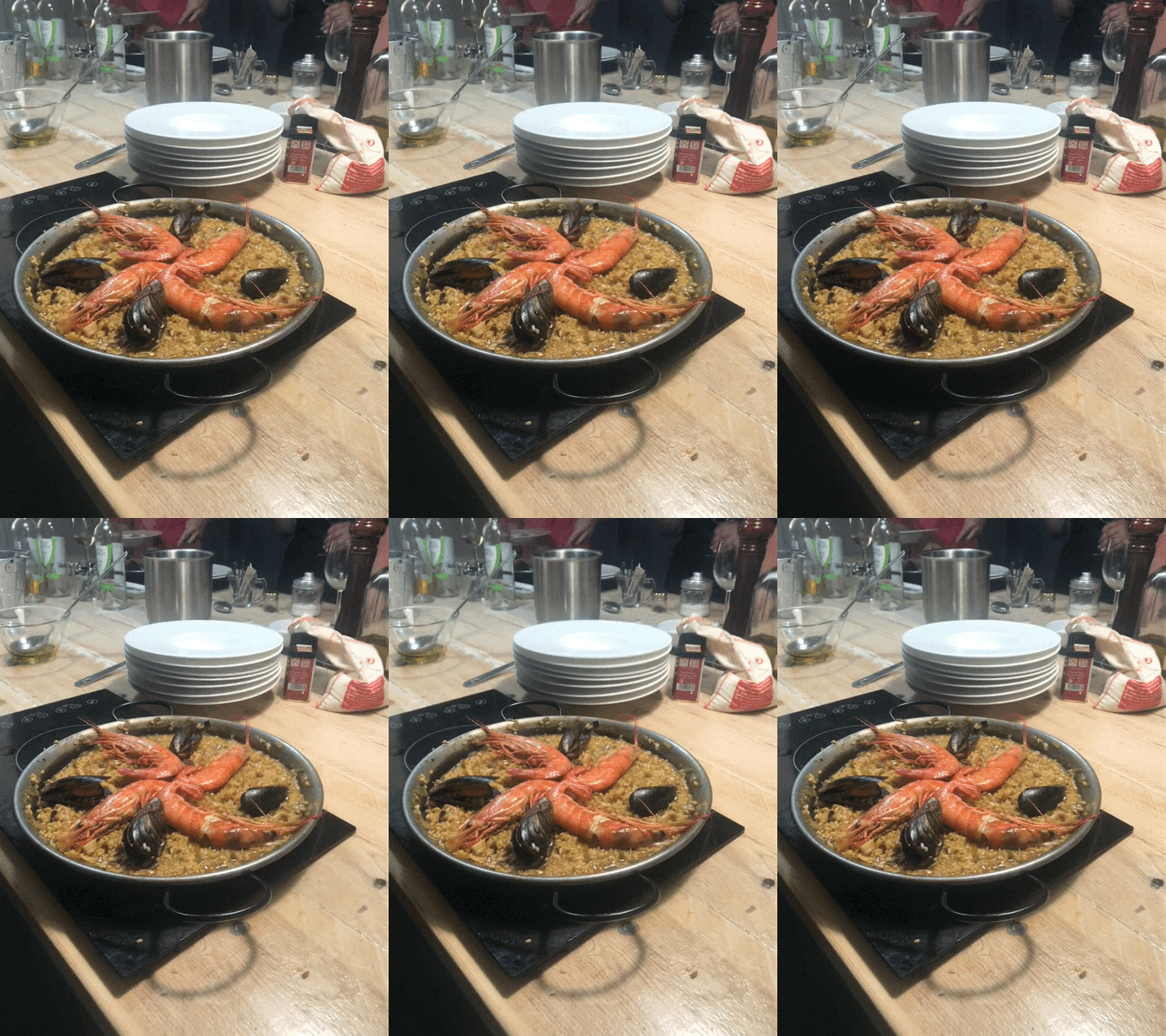
Traditional Spanish Paella

            Slogging across the Rambla, a main thoroughfare in old
Barcelona, skittering past motor scooters and an onslaught of cars, dodging
between pedestrians and avoiding the collapse and spillage of a full cart of canned
beer onto the sidewalk, we made our way into a courtyard.  As luck would have it, it was in yet another
courtyard where we found the door, rang the buzzer, and were allowed to ascend
to the third-floor apartment— (which in Europe, of course, is the fourth
floor).  Oh, my! No elevator here!  Four floors of winding uneven steps on both
wood and stone in a darkened stairwell, we wound up, up, up, until we were finally
swept into a veritable blast of air-conditioned wonder.  As we headed to the nearest sofa to collapse,
our cheerful host and cooking instructor, Teresa, thrust a couple of glasses of
water into our hands.  Saved!

            Surprisingly, we were early, and I had a moment to look
around the brightly lit, modern and nicely appointed rooms.  Black and white tile floors swept through the
dining room (already formally set for ten) and sitting room with a white fireplace
(not needed right now).  Vases with arrangements
of driftwood and green plants. Chrome and white chairs, sofa and bar stools composed
the sitting area.  And separating the
modern cooking station with seating for ten was an ornate Moorish-style room
divider. Classy!

            Within moments of our arrival, other stalwart sorts lumbered
into the room, grabbed glasses of water, and before introductions could even be
made, we were rushed out the door and back down those same dark steps—did I
mention the darkness before?—and into the furnace of the day.  We were off to the Farmer’s Market, which was
only a few short blocks away and right off the Rambla. 

            Now, I must tell you, I absolutely love the colorful
array at a farmers’ market.  The displays
and tables are piled high with the most luscious and lasciviously arranged red,
purple and blue fruits, melons and berries. 
Piles of pink shellfish with silver and black freshly caught seafood
were cradled in troughs of ice.  Ah, but,
assortments of fresh local cheeses, olives, Iberian ham and salami slices were held
in second place to the famous acorn-fed Jamón Ibérico de Bellota (black
hams) which were hanging on hooks wearing personalized black zip-off
coats.  (Oh, this could set one back a whole
month’s salary.)  Plus, there were
displays of fresh pastries, almond candy nougat, saffron and more spices in
abundance.  (Oh, but no black pepper and
I’ll tell you about that later.)  My
senses were on overwhelm on this magical whirlwind tour. No, we were not given
time to purchase anything, yet I had discovered a treasure trove of edible
delights and was in my glory.

            Teresa introduced us to her favorite purveyors, we bought
only fresh tomatoes, took another quick look over our shoulders, and hurried
back down the boulevard.  (She had
shopped earlier that morning—6 a.m., I believe—for all the fresh seafood we
would be preparing in the many different recipes she had in mind for us.)  Back up those lengthy steps we went, and
before settling into our seats at the demonstration table, glasses of water were
once again administered–and, oh, white wine was also served.  Okay now, we were ready.

            We donned our black aprons and leaned in close as Teresa
began teaching us some of the finer points of Spanish cuisine.  “Some of you might consider Spanish food to
be spicy,” she began, “but that is not the case. We love our food, but we do
not love spicy food. So, if you find a black pepper shaker on a table in a
restaurant, please know that it is only for you tourists.  We never touch the stuff!” she said with a
lift of her chin.  And, then she
smiled.  We were already eating out of
her hand and . . . oh first we started with the preparation of tortilla de patatas, of which
we needed to cut the onions, potatoes, break a few eggs, and boil the potatoes
in two cups of olive oil. 

            “Two cups?” we wailed. 

            “Oh, my yes.  But
we always reuse our olive oil. It is perfectly good for a number of days after
its first use if stored well.” 

            We were dumbfounded. 
Who knew?  I buy my olive oil through
an olive oil club, which is much like a wine club, but not quite, and the price
of a few precious ounces can give one pause for overuse.  It was obvious I had much to learn.  And, we still hadn’t started on the paella!

           In the course of three hours more, with plenty of ‘cooking’ wine to sustain us, we were able to participate in the creation of the Tortilla Patata, which is a potato omelet; Pescaito Frito (small fried fish); Catalan Cream (Spanish crème brulée); Spanish grilled jumbo shrimp; and—ta da!—seafood-filled Paella (with mussels, clams, calamari, squid, and jumbo shrimp, oh my!).  Definitely the freshest tasting and best paella I’ve ever encountered!  Well, you had to be there!  And, you could be, if you just contact the folks at Just Royal BCN the next time you are in Barcelona.  It was certainly an experience of a lifetime and one more peek inside another exciting culinary culture.  Olé!  Olé!

Carole
Bumpus

www.carolebumpus.com Snap Herplex Hub
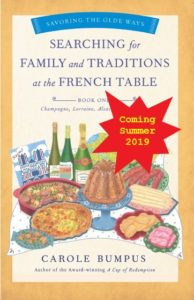
A Peek at the Prologue to Upcoming book, Savoring the Olde Ways – by Carole Bumpus

Have you ever strolled down a cobblestone street in a foreign village, passed an open window, and heard laughter flowing out to greet you?  Did you stop to listen to the banter and wonder what it would have been like to live there?  In that house?  That village?  And oooooh—what was that wonderful aroma?  What could they possibly be preparing for dinner?

My upcoming book series, Savoring the Olde Ways, due to be launched August 27, 2019, is a compilation of stories and traditional recipes I had the good fortune to gather during interviews and conversations with families as I traveled throughout France and Italy. Part culinary memoir and part travelogue, these books present the personal experiences of three generations of families, as told to me inside their homes, along those very streets.

The first book of my series is called, Searching for Family and Traditions at the French Table, Book One.  It is the first half of a culinary adventure I took with my dear French friend, Josiane Selvage, from Paris in the Île-de-France, through the Champagne, Alsatian and Lorraine Regions before returning to Paris.  The second book, Searching for Family and Traditions at the French Table, Book Two will be the completion of this adventure beginning in Paris, and heading north into Pas-de-Calais, Normandy, Brittany, Loire and completing the tour in the Auvergne.  The scheduled launch date for this second book is August 2020.  The third book moves into Italy and is called, Searching for Family and Traditions at the Italian Table, Book One.  This one will arrive in April 2021.  Oh, yes, and there is so much more to come–from both countries.  Come join me as we sip and sup throughout these culinary travel experiences! Snap Herplex Hub

I was born on November 11, 1918, Armistice Day, the last day of World War I

(A revised excerpt from A Cup of Redemption, an historical novel) 

“When were you born?” I asked Marcelle Zabé, my 83-year-old French guest.  My question must have floated out of the blue, but Marcelle immediately put her coffee cup down on the table and sat forward.  The deep lines in her face smoothed as her rich voice lifted.

“I came into the world with a bang!” Marcelle Zabé resounded. “Gunshots, shouts of wild rejoicing, cries of joy and great jubilation echoed through the streets of my hometown, Vannes in Brittany,” she said, as her hands took flight.  A new sparkle danced through her eyes.

Music played in the streets for the first time in four years. People danced, sang, hugged and cried. It was quite a wild affair, I was told. Not just for my birth, of course,” she laughed, “and, not just for Brittany, but for all of France. I was born on November 11, 1918…Armistice Day, the last day of World War I.” Her voice held a triumphant lilt.

She stopped talking for a moment, picked up her fork and stabbed a morsel of lemon tart.  Popping it into her mouth, her eyes rolled, and she swooned.  I was pleased that she approved of my meager culinary talents.  Then, Marcelle continued her story. 

I had been interviewing Marcelle, along with her adult daughter, Josiane, about French foods, recipes and family stories in the comfort of my own kitchen.  As a retired family therapist, I had been relaxing into the idea of gathering stories for a book I was thinking of writing.  It could be more like a cookbook with family anecdotes, I remember considering.

“My Grand’mère often told me the celebration was just for me,” Marcelle continued.  “Why, they even thought of naming me ‘Victory.’”  She laughed again at the old family tale which rolled off her tongue as being oh, so familiar.

“Grand’mère used to tell me many things about that time, as she was the one who raised me.”  Marcelle closed her eyes for a moment as she reflected back over her more than eighty years.

“What did people do during the Great War, Grand’mère?’ I used to ask her. I must have been seven years old when we first started this game. ‘Well, ma Cherie, it was a difficult time,’ she would respond. ‘The men who marched off as soldiers in November 1914 expected to return home in time to eat their Christmas goose. Everyone was surprised when the war lasted four very long years. No men were left to handle the fishing boats,’ she would say, waving her hand in the direction of the nearby sea, ‘and, no men were around to bring in the few crops which grew. War was not a time for choice, Marcelle; only a time for survival.’

“‘So, what happened after the War?’ Marcelle said as she continued to recount her grandmother’s words, “and always I received the same response, ‘The losses of men left mothers, fathers, young wives…all weeping in the still of the night or filing into the Church to pray to their saints. Your mother was among them, you know. Many a day, the only sound to be heard was the chink…chink…chink…of the masons chiseling the names of those who died into stone on the village war memorial.’

“‘Was my father’s name among them?’ I would ask her.”  Marcelle stopped short, she turned to me, and said, “But no answer ever came my way.”  Her eyes dropped to her now-empty coffee cup.

My head instantly snapped to the side to catch her daughter’s reaction, as Josiane had been quietly translating her mother’s every word.  I know my eyes must have been boring into her to prompt her to give me some clue.  Where should I go from here?  As a therapist, I knew the importance of her mother’s statement and this was huge!  I didn’t want to pry, but I also didn’t want to blithely continue a simple interview about French food and families if this was uncomfortable.  Josiane continued to stare into her own cup.  After a moment, she looked up at me and shrugged.

* * * * * * * * *

Marcelle Zabé was born 100 years ago today – November 11, 2018 – into a world celebrating the end of the Great War.  But what Marcelle was forced to contend with during her entire 84 years of life was the lasting burden of war.  She carried the last name of a father she never met—knew nothing about.  Had he died during that cataclysmic war or just failed to return home?  Were her parents even married?  Any conversation on this subject was always swathed into silence.  Abandoned, too, by her mother due to economic circumstances, her greatest influence was her grandmother. Despite her difficult start in life, her subsequent trials as a single mother during World War II, and her contentious marriage to a former Maquis (World War II résistance fighter), she achieved the highest goal she had set for herself. She was the proud mother of four fine children and an appreciative and loving passel of grandchildren.  Why?  Because she had learned the hard way – what war steals away from family can only be restored with patience and love.


Snap Herplex Hub

An Immigrant in My Own Country – France – 1943

Gare d’Austerlitz, Paris

April 1943

The train was packed with people like me, hoping to find a new life and a place without fear. I had not wanted to leave my job in Paris, but I could no longer count on my safety or that of my sweet baby, Gérard. I had no choice. Plus, I had to find my seven-year-old son, Thierry. Months before, he had been sent off with all the other school children in Paris to keep them safe from Allied bombing.  I knew little about where to find him, but once I received my travel pass, I decided I must join him. No one remained safe in Paris. Even André, the father of our beautiful baby.  But, he was to stay behind until his travel papers arrived.  For some reason, I wondered if he had requested them.

The train, itself, stunk to high heaven—-of cigarette smoke, bodies too long without a bath, baskets of food that had seen better days, plus the reek of urine and coal smoke.  German soldiers pushed their way onto the train, shoving into the best seats and elbowing the elderly and children into the aisles.  When I first saw them, a wave of fear enveloped me. I was not used to having soldiers so close by.  Immediately, I clutched dear Gérard, close to my breast.  Eight-months-old and he was all I had left of my love.  André.  My love.

There was nowhere to sit, so I, along with the children on the train, crouched down in the aisle.  As the train lurched forward, I caught a glimpse of André through the window, but because grime coated the window, both inside and out, it was barely a glimpse. I wondered if this would be the last time I would see him.    I tucked my few belongings under my feet and shoved my small inadequate basket of food under a seat. I looked around to see if there were facilities. If there were toilets, they were far, far away, and of course, no food service was available, not that I had any money for such things.  Again, a wave of weariness swept over me.  I steadied myself for the lengthy ride to the Auvergne, to the ‘l’interieur of France’, where I was told my seven-year-old son, Thierry, would be waiting.

As I looked down the corridor of the train, a German soldier caught my eye and gestured for me to take his seat.  Grateful, I swallowed the revulsion I felt for the Germans.  I rushed forward with my baby.  Quickly, I shoved my things under my seat and that is where we stayed for the duration of the trip.   Travel aboard a train had become quite dangerous, as the trains had become an open target for Allied strafing.  I tried to block this from my mind, as there was no other means of travel for us and I was determined to spare my children of any further trauma.

I allowed my mind to drift back to Paris.  Paris had become so dismal.      So bleak; so hopeless.   The sky had seemed a ceaseless gray, with the black soot of progress drifting down upon us.  But, whose progress was it?  I had not seen it.  I had had to scramble to make enough money to pay the nurses who kept my sons, which meant that many times I went without food myself.   If I had not been sharing my life with André, I’m not certain how I would have survived.

The train stopped and started at every village along the route.  The German soldiers were continually getting on and off, checking our papers repeatedly, riffling through our belongings—what we had anyway—and then the train stopped for a long time in Orléans.  What now?  What is happening? Was that the backfire from a car?  Was that a gunshot? Suddenly, I heard someone offering  café au lait outside the train window.  I propped Gérard on the seat, quickly lowered the window and ordered a large bowl of café.      The hot, rich coffee was like a salve on a cut; something I was familiar with but had not had in some time.   For a few moments, it helped stave off my fear, but, I remember holding the bowl between my hands and noticing I was shaking.   Once again, I was facing the unknown, alone.   A blast of the train whistle brought me to the present.   And, just as the train lurched forward I passed the bowl back out the window.

The train inched across the Loire River, and I noticed for the first time, that it was spring.   The terrain we had been crossing before Orléans, held wide expanses of plains and soft undulating valleys, but as we inched along, I noticed the landscape shift dramatically.  I caught my first glimpses of what would be my new home.  I had heard of this area of Central France, the Massif Central, but had no idea what I would find.

I grabbed a diaper and wiped a spot clean on the window to peer out.   A thrill of anticipation rippled through me, and I held Gérard up to the window so he, too, could see.      The train crossed and re-crossed rivers and gorges and entered onto a fertile river basin of the Limagne.   I had heard that dairy and beef cattle luxuriated in these meadows, but I also knew the war had taken its toll here, too.  Only a few cows were left grazing.  I looked for sheep or goats to point out to Gérard, but spotted only two, tethered close to a farmhouse near the tracks.  Yet, the fields of wheat had ignored the happenstance of damage from local shelling.  The wheat had turned chartreuse green and was shooting tall, almost as if in a spirit of rebellion.

The mountain range with its volcanic peaks and lunar landscape was something I will never forget. When I saw the deep gorges filled with the rush of water from the spring run-off, I suddenly was anxious to wash myself clean of the dreary, grey of the past, and of the dinginess and terror of war.

* * * * * * *

Just at the moment I felt I could relax, fear once again became my companion.      Outside the window, the glint of a plane swooped down over us. I knew one of the Allied targets was railroad bridges, and I stared down through the deep gorge below me and prayed for our safety. There was nothing I took for granted.  I bit down hard on my lip to keep from crying.  Suddenly, I caught a glimpse of Puy de Dôme, the highest mountain of the volcanic peaks.  As a young student in Brittany, I was taught that this was once the royal mountain to the Celts; a place where they worshiped their god of war.  At the time, I thought it was another connection to my Celtic heritage. But now, I could only cry out ‘We’ve had enough war.  We’ve had enough!’  Immediately I prayed to Ste. Anne to keep the war far away from the Free Zone.

Despite the perpetual clatter of the train, I returned to viewing the beauty outside the window. The wildflowers, which were scattered up and down the mountain sides, were in a profusion of yellows, pinks, and purples—flowers I had never seen.  I saw villages perched so high on ridges I thought they would surely cascade into the valleys below.  I watched children running through the fields in play, or precariously riding their bikes along rocky ravines.   And I thought of my son, Thierry.  This was a perfect place for him.

Softly, I told Gérard of the picnics we would go on and the vegetable gardens we would plant together, as farms blurred past.   He wriggled in my arms, as if fully aware of my recitation.  Narrow roads wound through forests of oak, pine and chestnut.  I fantasized about the chickens, ducks and rabbits that we would raise and of going fishing in those lively brooks.  Yes, this was a pastoral scene we all could call embrace.   Then reality snapped its fingers once again as German soldiers flashed past my window as they marched along those very same ‘pastoral’ roads.  My head throbbed from the constant jolting of the train, and I had the realization that I had not left the war behind after all.

Once I arrived into the region of the Auvergne and the village of Evaux les Bains, I was very weary.  I feared I could not go farther.  I couldn’t remember the last time I had slept.  Shifting Gérard onto one hip, I slung our bags onto my shoulder.  I was desperate to find Thierry.  I asked for directions to the village of Mainsat from the local peasants, who reminded me of my beloved Bretons.  Their regional dress was so familiar—the women were in black, full-length dresses with white aprons and round, white lace coifs on their heads, while the men wore dark blue denim smocks over black work pants. I felt like I had arrived back home.  I relaxed and set my valise on the ground.    Immediately, I realized their regional dialect was not one I understood.  And it was clear, they did not understand me.  Again, I requested directions and during that interim, my presence was met with a distant and cool demeanor . . . one of intense antipathy.  The tension in the air felt electric and I realized this was not my home.  At last, I was given directions; some I understood; some I did not.  They made it clear that the Amberts lived outside the village of Mainsat on a small farm . . . over eight miles away.

I shifted Gérard once again onto my other hip, picked up my valise and began to walk out of town.  Shame swept through me, as I heard what sounded like a cat-call.  The words, ‘saleté refugiate,’ were hurled my way.  Even though I had no idea what they were saying, I knew by the tone and the curl of their lips, I was not accepted.  Even the intent of the words struck at my heart.  Will I ever find my place?  Born on the last day of WWI, never knowing my father, rejected by my own mother, and cast aside for most of my 20-years of life, I wondered if I would ever find my place.  As I continued to walk away, I realized the meaning of those words, ‘filthy refugee’.   To have such foul words flung at me at a time when I already felt so abandoned, it took all my reserves not to drop to my knees in defeat.

Finally, after watching me kick and drag my luggage down the road while clutching little Gérard, one of the locals, more curious than anything else,  I presume, offered me a ride on his farm wagon.   We didn’t communicate much, but it became abundantly clear that my presence in the valley was not wanted.  I think they just wanted me to move on and this was one way to make that happen: to physically remove me from town.  I couldn’t blame the people; war had obviously arrived in the Free Zone and everyone was under suspicion.  For all they knew, I could be a collaborationist.  Unfortunately, I had no choice about whether to be in the Auvergne or not.  I was there to find my son.”

Snap Herplex Hub

Good Things Come to Those Who Wait

March 20, 2018 – First Day of Spring

I believe in the adage “Good things come to those who wait” but in this case, the adage should possibly read, “Good things come to those who wait and wait and wait!”  Yesterday, I made a commitment to have my publisher, She Writes Press, who published my first two books, A CUP of REDEMPTION and RECIPES for REDEMPTION, publish the first three books of my new series, SAVORING the OLDE WAYS.  The first book, SEARCHING for FAMILY and TRADITIONS at the FRENCH TABLE – BOOK ONE is a culinary/travel memoir about travels through the Grand-Est of France.  This tour will include the regions of Champagne, Lorraine, Alsace and I’le de Paris and will be coming out in July 2019—yes, a year away!  The next book, SEARCHING for FAMILY and TRADITIONS at the FRENCH TABLE – BOOK TWO, will be the conclusion of the same culinary trip but will head out of Paris and take in Normandy, Brittany, the Loire Valley and ending in the Auvergne.  It will be released in the Fall of 2019 and the third one, SEARCHING FOR FAMILY AND TRADITIONS at the ITALIAN TABLE, will be released in Spring 2020.  Yes, it seems like a long time to wait, but then this has been a journey-of-the-heart of which I began over twenty years ago.  So, I suppose I shouldn’t ‘get my undies in a bunch,’ so-to-speak.

*********************************

As a quick peek into the first book, let me entice you with this little tidbit

The bitter, sharp April wind howled all around us as my husband, Winston, and I shoved our luggage into the back of Josiane’s car.   Josiane, our French friend from California, and Martine, her cousin’s wife from the nearby Champagne Region, had arrived to pick us up at our hotel in Paris. I noticed the two were dressed in a most chic and colorful manner—typically Parisian, I surmised. My eyes dropped to my own drab slacks and gray top. Six months after 9/11, and I evidently had taken the U.S. State Department’s edict seriously: “Don’t look like an American.”  I sighed.

About a year before, I had retired as a family therapist to go traveling through France and Italy with a culinary arts teacher and chef.  We both were on a search. She searched for traditional recipes and I followed suit by interviewing the families who prepared those recipes.  And, of course, their stories.  It was then I decided to start writing a book about French families, their traditions and favorite foods.

It was purely a fluke that a mutual acquaintance introduced me to Josiane back in my hometown in California. But it was not until she, along with her mother, Marcelle, offered to ‘enlighten’ me about their family’s traditional recipes that I was truly hooked.  From the day they arrived in my kitchen for the first of several interviews, my life was never the same.  Over cups of coffee and wedges of lemon curd tart, we stumbled through our language barriers to form a most incredible bond while sharing our own cultural stories.  One of our first conversations reverberated through my mind:

“So, you are interested in learning how to prepare our French cuisine, n’est ce pas?” Marcelle peered over the top of her coffee cup at me, as she spoke.

“Oui, Madame,” I said, “I would love to learn what makes your cuisine world-famous; your haute-cuisine.”

“Our haute-cuisine?”  Marcelle took a bite of the lemon-curd tart I had so painstakingly baked, hoping this would meet my guests’ approval.  A twinkle flitted through her dark eyes.

Oui,” I said, in my best French, “but more than ‘haute-cuisine’ I would prefer learning the fine art of traditional French cooking.”

Marcelle carefully dabbed her lips with her napkin.  “Well, Madame, our traditional cooking is rarely considered fine, but we certainly keep a respectable ‘cuisine pauvre.’”

I was brought up short with this French term and quickly turned toward Josiane for an explanation.

“Carole, ‘cuisine pauvre’ means ‘poor kitchen’ and refers to the traditional-type of peasant cooking.  These are the recipes that have been handed down through the many, many generations in our own family and are the type of cooking Maman has taught me.”

Well, that certainly caught my attention.  But, it was when I asked Marcelle what foods she served as a young wife in France, that I was fully caught off guard.  This 83-year-old woman threw her head back, laughed, and then said, “Well, we never had to diet.  That’s for sure!”  She took a sip of coffee and continued. “It was during World War II, you know.  My husband was part of the French Resistance—a Maquis—and we were all in hiding from the Germans.  We were lucky to have even one small potato to share between us, but we managed.  We were family.”

It was at that pronouncement, my life changed.  There was no way back.  Following these talks, with a few cooking classes tossed in for good measure, Josiane offered to continue my ‘education’ by guiding me through France—on a culinary tour with her mother. What could be more enjoyable? The idea of traveling with these two delightful women, while searching for traditional family recipes and learning more about their history sounded like a dream. I couldn’t wait!

But, we were forced to wait.  When the tragedy of 9/11 occurred, our original tour was cancelled, and a month later, dear Marcelle passed away.  The news was devastating on all fronts and I assumed all would be cast aside.  But Josiane informed me she still wanted to take me to France.  “In fact,” she said, “it would be our tribute to my Maman.” I couldn’t refuse.

Shaking the reverie from my mind, I wrapped a purple scarf about my neck, jumped into the backseat of Josiane’s car and strapped myself in beside my husband. This was, after all, the first day of my long-awaited culinary tour! Snap Herplex Hub

SALETÉ RÉFUGIATE – DIRTY REFUGEES

SALETÉ RÉFUGIATE – DIRTY REFUGEES

REMEMBERING WORLD WAR II – PARIS:  MARCELLE RECALLS DIFFICULT MEMORIES

“You asked me what I remember about the beginnings of World War II in Paris,” Marcelle responded.  “What my life was like?  How I lived?  Let me see if I can remember……”  She sat quietly, running her index finger round and round the handle of the coffee cup before her, her mind racing back to her teens over seventy years before.

“Now, you probably know that Hitler came to power in 1933,” she began.  “I don’t think we thought much about it at the time, and I, of course, was too young to think of such things.  As you know, I was born on the last day of WWI.  So, I knew little of what caused war . . . although being French, politics was always under discussion.”  A twinkle flitted through her dark eyes.

“I do know that when the Spanish civil war began in ‘36, it became a dress rehearsal for what was to come, for Hitler was testing out his dive-bombers at Guernica.  We should have taken note.

“But, in 1936, I moved to Paris, where I gave birth to my son, Thierry.  Because I was an unmarried teen-age mother, I never returned to my grandmother’s home in Vannes and avoided my mother’s home in Paris.  It’s a long story, but it seemed better that way.”

“It must have been very difficult for you—being so young and on your own,” I said.

She shrugged her stooped shoulders and pulled her sweater more tightly around her.  A look of determination swept over her weathered face.  “I found that ‘family’ comes in many different forms.  You see, I was not the only young mother in Paris….and I made a network of friends.  Fortunately, I found a good job working at the Citröen factory and my beautiful son was cared for by the child care workers for factory employees.

“Like I said, the year was ‘36, and there was great turmoil going on in Paris.  At that time we didn’t know France was headed for war once again.”  She cocked her head to the side.  “But I remember that the atmosphere simply crackled with talk of it.

“I faintly remember hearing about such things, but not understanding what was happening.  Everything is made clearer in hind-sight, as they say.  I think it was around the time when both Germany, then Russia, invaded Poland, that we began to see that we needed to prepare for war too, but I suppose it was already too late.  The massive numbers of refugees were already beginning to fill the streets of Paris…..streaming down from the north.

“It was on September 3rd, 1939, when both England and France finally declared war on Germany, that it became real for me.  That was when the Communist Party was banned and as a factory worker, that meant that I no longer had as many rights.  Same as a union worker.  At least I still had a job, and that was what mattered most to me.

“The eight-month period which followed was known as the ‘phony war’ – Drôle de Guerre – phony, because although war had been declared, there was no fighting.  None at all!  Everyone was waiting to see what Hitler would do next.  Waiting for the other shoe to drop!  I guess we felt pretty superior as we had beaten Germany in WWI.  And we were relying on the defensive Maginot Line that had been built after World War I, along our northern border.    We were constantly being told by our government that we were all safe…..and, of course, we believed them.  We had no idea what was to come.

Not until the bombs began to fall on our beloved City, did we realize the danger we were in.  I remember it was the 3rd of May, 1940, the Germans began bombing Paris.  An estimated 1,000 bombs were dropped and the very Citröen factory where I worked became a major target.  The factory was seriously damaged and set ablaze; glass and debris littered the streets all around.

“As all of our workers raced into the Metro, we were handed WWI gas masks.  We had been told to expect the Germans would be using gas.  I tried not to panic, but we were all so frightened.

After the bombing raid was over and we came up from the Metro, a concrete air raid shelters across the street, crowded with women and school children, was crushed with all of its occupants mutilated beyond recognition.  Again, I could only think of my dear son.”

I could barely breathe until I received word my Thierry was safe.  I was, indeed, grateful.  Oddly, though, after those first bombs fell, I felt panic, yet there didn’t appear to be panic around me…. only outrage and a sense of unreality—a feeling that such things could not possibly be happening to us.”

It was on or around the early part of May, 1940, when Hitler ordered the invasion of France.  Again, we French relied on our expertise on the ground.  We hadn’t planned for the Nazis’ strong ‘blitzkrieg’ (air tactics), and within two days, the Germans had cut through our beautiful Ardennes forests …..where we didn’t expect them at all.  And they had gone around the infamous Maginot Line.  How could that be?  We French had constructed this wall with the best instructions from our most famous WWI general, Martial Pétain!   But, the Germans had completely cut off all means of French attacks.  We heard that Churchill ordered a massive evacuation from our French port at Dunkirk, where tens of thousands of soldiers were transported back to Britain including many of our French soldiers.  But, still, there were massive numbers of ships bombed and hundreds of our men lay dead or were dying on the beaches and in the waters.  It wasn’t until we heard the radio reports from Dunkirk, that we finally realized we were truly no longer safe.  In retrospect, all the signs were there . . . . but, it was too late.”

“I can’t imagine how frightened you must have been,” I said.  Guilt riddled me for having brought this painful subject up in the first place. But I couldn’t help myself.  For some reason, I needed to understand how she was able to make it.  “So, what did you do?  How did you carry on?”

Marcelle took a long sip of already cold coffee and placed her cup solidly on the saucer.  I could tell she was envisioning the scenes of her past as if watching an old newsreel.  But she sat up straight in her chair and continued on.

“I remember walking to work on a June day back then.”  She paused.  “All seemed so quiet; it was hard to believe that we were in danger.  The skies were a beautiful shade of blue.  The air was warm with the coming of summer.  Everything seemed so normal.  People were laughing and drinking in the café below my windows.  In fact, I had waved to some of the women who were busy hanging their wash on the lines out back.  Why, the people in our pension seemed to be going about their business like always. Edith Piaf’s voice lilted down to me from a radio in someone’s window.  But, then, I heard a news flash on the radio that thousands of people were streaming toward Paris…. mothers, children, and the elderly were marching south on the roads, because Dunkirk had been completely destroyed.  No men accompanied them, as they were either dead or captured by the Germans.  In addition, we were hearing constant reports of our French soldiers running just ahead of the Germans….but, without any weapons of any kind.  Was that true or propaganda?”

But by June 10th, I, along with my fellow employees, were told to prepare to go directly to Bordeaux.  A new Citröen factory was to be built.  We all made arrangements to make the journey, packing everything we could carry in one valise.  Even though I had no choice but to leave my four-year-old Thierry behind, I dreaded abandoning him.  My mother had done the same to me.  But, now I better understood her.  When it’s the only job you have . . . you must go.  And I was promised Thierry would be safe until I could bring him to Bordeaux.”

“As the Germans entered from the north into the back door of Paris, the flood gates of humanity poured out to the south and to the west.  Millions of people became part of a forced march, or as it came to be known, L’Exode de Paris, or the ‘Exodus of Paris’.  It was all so sad,” Marcelle intoned.  “We thought that as Citröen employees, we would be able to take the train.  But, as it turned out, we became like the rest of the refugees, forced to walk.  All the way to Bordeaux . . . 499 km. or 310 miles.

It was common to see little tots being carried, small carts being pulled by animals, big people, old people, children, all carrying everything they could possibly carry….everything they owned.  It was like we now see on T.V….but, from other countries. Families were evacuating the only lives they had ever known.  On that day we became part of the ‘Saleté Refugiate’ or the ‘dirty refugees’.  Unfortunately, that was not the last time we felt that scorn from our own countrymen.

“At the same time, unbeknownst to us, the French government had also fled to Bordeaux, leaving the war hero, Martial Pétain in charge.  They hoped for time to restructure the French government in relative safety.  As we all left the City of Lights behind, none of us knew what we would find at the other end of the road.

“Within a matter of days, the Germans had taken hold of Paris and, General Martial Pétain—that same WWI French war hero—had surrendered all of France.  How could that be?  We were stunned! We had been sold out like rabbits!  Even the French government had been left out of the debate.  But, even though we French harbored great resentment, we knew we must work and we must survive.

“Six weeks later, desperate to see my son, I, like so many of us, returned to Paris.  We proud French did not want to work for the Germans, but pride did not feed us or our children.  We had no choice! We were forced to return to the repaired Citröen factory, but this time to work for the Germans.  And this time we were forced to manufacture weapons to be used on our own people.”   She sighed and shook her old head sadly.  “At least my son was safe and that was all that counted—all that ever counted to me.”

Interview with Marcelle Pourrette which led to the historical novel, A Cup of Redemption.

Snap Herplex Hub

Fall, French cooking and San Francisco, a Bon Appetit combination with Les Dames d’Escoffier

Fall, French cooking and San Francisco, a Bon Appetit combination Special

Posted Nov 5, 2016 by Jonathan Farrell

Bay Area based author Carole Bumpus was delighted when she got the news that she and her companion cookbook, ‘Recipes for Redemption’ from her novel ‘Cup of Redemption’ were invited to the “Literary Feast” of Les Dames d’Escoffier on Nov. 13.

Founded in 1989, Les Dames d’Escoffier-San Francisco Chapter is an invitational organization of women leaders in food, beverage and hospitality whose mission is education, advocacy and philanthropy.

Maurine Killough, courtesy of Les Dames d’Escoffier, SF Chapter

“It’s just for cookbook authors she told this reporter, and some of the best in the world. So, I’m pretty stoked.”

Founded in 1989, Les Dames d’Escoffier (LDEI), San Francisco Chapter is an invitational organization of women leaders in food, beverage and hospitality whose mission is education, advocacy and philanthropy.

“LDEI is an international organization of women leaders who create a supportive culture in their communities to achieve excellence in the food, beverage and hospitality professions,” said Karen Mackenzie speaking on behalf of the organization. “To do this LDEI members must share knowledge, support members and provide leadership, educational opportunities and philanthropic events for the larger community,” she added.

Fortunately for Bumpus, just like her novel “A Cup of Redemption” the opportunity to be part of this unique-one-of-a-kind event presented itself, unexpectedly. “As president of the California Writers Club for the San Francisco-Peninsula branch, it is my job to keep all of our members informed,” she said. “It just so happens that my newsletter editor also works with Les Dames d’Escoffier and also the San Francisco Professional Food Society, explained Bumpus. She was so taken with my novel and its companion cookbook, “Recipes for Redemption” that she approached Les Dames d’Escoffier; and it went from there.”

“Confirming its role as one of the world’s top food cities, San Francisco boasts more award-winning cookbook authors than any other city on Earth, and many of them happen to be both women and members of Les Dames d’Escoffier,” said Mackenzie.

Among the top chefs and authors participating in the event are Teri Sandison, Paula Wolfert, Dorie Greenspan, Joyce Goldstein, Diana Kennedy, Jerry DiVecchio, Amy Guittard, Leslie Sbrocco and Georgeanne Brennan, among many others. The authors will be offering signed copies of their books for sale, and many will offer samples of favorite recipes featured in the cookbooks.

Funds raised through the sale of $10 advance tickets ($12 at the door) will benefit the Culinary Scholarship Fund of Les Dames d’Escoffier San Francisco. For more than thirty years, the non-profit organization has supported aspiring women chefs, authors, scholars, and hospitality professionals.

“Never before have so many leading lights of the culinary world gathered in one place specifically to meet fans, share insight, and raise funds for a worthy cause,” said Helen Roberts, president of the San Francisco chapter. “This is a once-in-a-lifetime event that brings together more culinary talent under one roof than ever before.”

Bumpus noted that she is very honored and grateful to have been invited. Her book “A Cup of Redemption” and its companion cookbook emerged very unexpectedly during her travels as a food and travel blog writer. She was in France and while asking a local French woman about what she prepared for meals at home, the woman began to talk (through an interpreter) about experiences of World War II. The woman’s life-story was so compelling that Bumpus went back to France after her initial trip for the blog and spent the next 10 years, arranging the basis of the woman’s story into a novel.

The companion cook book to the novel “Recipes for Redemption,” features all the food dishes mentioned in “A Cup of Redemption.”

Courtesy of Carole Bumpus

The companion cookbook to the novel “Recipes for Redemption,” features all the food dishes mentioned.

“They will be selling my cookbook at the event and I will be bringing 100 little ‘amuse bouche’ which I will make myself, to sample. Nice trade-off,” she said. “I’m probably the very least known in this realm.”

Yet even so, the recipes Bumpus featured in her companion cookbook were impressive enough to inspire a chef, Geoffroy Raby to place them on his menu. Raby who is owner of Cuisinett, an authentic French bistro on San Carlos Avenue, just off El Camino Real in San Carlos, has been reaching the hearts of Peninsula customers with his down-to-earth approach to the classic French cuisine.

Bumpus is looking forward to the ‘Literary Feast’ event which will be held at San Francisco’s Ferry Building on November 13, from 3-6 PM. Advance tickets are available through the CellarPass web site. For further details visit the Les Dames d’Esscoffier, San Francisco Chapter web site.

Read more: http://www.digitaljournal.com/print/article/478874#ixzz4PFvmQ7O0


Snap Herplex Hub

Continuing events for both A Cup of Redemption and Recipes for Redemption – October 2016

It’s been a year since Recipes for Redemption: A Companion Cookbook to A Cup of Redemption came into the world and almost two years since A Cup of Redemption made its debut!  It has been quite an interesting couple of years!  Who would have guessed my novel would end up winning, not only national awards, but also international recognition?  And, my little cookbook is no slacker!  It, too, acquired awards both here and abroad and took me into culinary arenas I never thought imaginable . . . cooking schools, food historian dinners, a fun ‘French bistro night’, private culinary events in both Southern California and Austin, Texas . . . Oh, and my cookbook was also featured in a local French bistro, Le Cuisinett for six months.

This past week-end, I was able to read from my novel, A Cup of Redemption, at the infamous LitCrawl–LitQuakes literary week of authors in the Mission District of San Francisco.  Yes, it was raining cats and dogs, but it was a cozy place for a group of us authors and also for those who had come in out of the rain to listen.  Always a fun time to be shared with many!

Next month, on November 13th, I will be involved in something I could never have guessed possible.  I have been invited to participate in Les Dames d’ Escoffier – San Francisco Chapter’s special event—‘A Literary Feast’.  There I’ll be, along with many of the world’s top-selling cookbook authors, who will gather for the first ever special event at San Francisco’s Ferry Building from 3-6 p.m.  We will be on hand to sign our cook books and to share ‘amuse bouche’, or small bites, from recipes taken from our own cookbooks.  You will easily find me!  I’ll be the one, stunned and in awe of being in the company of such culinary excellence.

When I first began to write of food and families, it never dawned on me that I would end up writing a cookbook.  Or that it would end up being such a fun way to continue the stories of my three main characters, Marcelle, Sophie and Kate.

So, after almost two years, I’m continuing to do what I have come to love best—to write about food, families, and the traditions that bind us all together.  Stay tuned as I string together more of my stories from Savoring the Olde Ways.   I did just return from Bordeaux, you know!

Snap Herplex Hub

« Older posts Newer posts »

© 2026 Carole Bumpus

Theme by Anders NorenUp ↑