Fiction and Non-fiction Travel and Food Writer

Author: Carole Bumpus (Page 11 of 12)

Three Seeds of Inspiration

ACupOfRedemptionHiRezSometimes inspiration comes when you least expect it. You may not understand its value at the time, but if you are lucky you plant the seed and curiously await the results. That happened to me a few years back, and planting those seeds has made all the difference.

Before I decided to write my debut novel, A Cup of Redemption, I was busy writing short stories involving travel and food memoirs. While interviewing an elderly French woman, Marcelle, about her favorite French recipes—cuisine pauvre, or “French peasant food”—she stunned me when I asked, “What recipes did you prepare as a young wife?”

“Recipes?” she answered with a not unkind laugh. “We were in the middle of World War II and my husband was part of the French Résistance. It was often too dangerous for me to sneak into the field to get a potato or two for my family. We were in hiding. Recipes? Now, that was something I only dreamed of.”

My original idea of writing a regional French cookbook slipped by the wayside as my desire to understand this woman became pronounced. How had this woman, who struggled under the weight of war, managed her family? How had she, along with so many other valiant women and families, survived with war scrapping on their doorsteps? I’ve written about this moment before but, for me, this was defining moment and my first “seed” of inspiration.

On a second occasion—actually, on a food tour in southern Italy, I was resting on a large rock near an ancient sixth-century B.C. Greek temple in Paestum. With rapt attention I was listening to a retired professor giving a short talk—not about cucina povera (Italian peasant food), which was the reason I was touring—but about military history.  He was waxing poetic about the battle which had taken place nearby in Salerno—not during Greek or Roman times, but during World War II. Waving his hand to the north and pointing beyond our view, he regaled us with the perilous happenings on those nearby beaches between the Allies and the Germans. With great detail as to strategy used, generals in charge, numbers of military involved, numbers killed and/or wounded, he explained the tragic outcome of that particular battle.

I nodded my head with interest, but waited until he completed his talk. Then I asked my question: “What about the people who lived here? How many were killed? How did families survive in the midst of this tragedy?”

He may have been dumbfounded by the naïveté of my question, but I, too, was left limp-jawed by his answer: “The military keep no records of unintended damage, injuries, or deaths caused by a military action, especially when it comes to unintended civilian casualties. It is known as ‘collateral damage.’ ”

I walked away from that conversation struck by the audacity of war and those who led it. I knew this gentleman was an expert in his field and he was only reporting on what was recorded, but I couldn’t get his words out of my mind: “It is known as ‘collateral damage.’ ” Not the people are considered collateral damage. I found the military’s total disregard of civilians—those vast numbers of men, women, children caught in the cross-hairs of war and never counted—was daunting. This was my second seed.

A year or so later, during a conversation with a young French woman, she mentioned her concern for her eighty-year-old grandmother from Bordeaux. The Twin Towers had come down, and so as the world was anxiously awaiting to learn if and when war would break out, her grandmother hit the reset button. Her experience of starvation in Paris during World War II was one she would never forget. And she was not taking any chances! She ordered a ton of potatoes to be delivered to her door. This was the third “seed,” for I began to realize how the impact of a war sixty years prior brought up memories along with a sense of immediacy and emergency for those who have lived with it . . . as did the following generations.

My novel, which focuses on three women—two French, one American, who separately experienced life-changing events during war—is about women’s struggles to rise up during and after the devastation of war. So, by the time I flew to France to follow up on Marcelle’s story, she had passed away and I was there to help her daughter unravel some of her mother’s mysteries. And it was there I was able to reap the fruits from the seeds of inspiration which had been planted.

Those three non-linear conversations—or seeds—propelled me forward for years—digging through archives, interviewing others, working with translators, reviewing  transcriptions, plus reading, researching, and reading some more. (This is part of the writing process, I promise you. And, by the way, research is probably one of the most seductive things you can do, as you don’t want to stop.)

So, why did I take you on this lengthy description of my writing process? For me, my passion and drive to write this novel—which took twelve years, by the way—culminated with three offhand comments or three seeds of inspiration. You see, the seed of a story can find you anywhere or any time. Snap Herplex Hub

L’Exode Out of Paris – June, 1940

4:30 a.m.  When Marcelle awakened that day, it had been another beautiful June morning. The cool air that swept into the small open window held the scent of jasmine and the promise of early summer. She crawled out of bed and inhaled the sweet fragrance.  She peeked out through the blackout shades to see if the sun would be rising shortly. It was too hard to imagine that Paris had entered into this nightmare. How could it possibly be?Paris has never looked lovelier!

By 11:30 a.m., Marcelle and her roommate, Gené, had packed their bags-only one per person—and had been waiting for the train to take them to Bordeaux. Since 5:30 a.m. In fact, their entire Citroën crew was congregated outside the Gare d’Austerlitz station. Standing on one leg, then the other, sitting on their belongings, shifting back and forth, all were waiting. Unfortunately, they were not alone. A mass of a thousand others surrounded them, all waiting for the same trains.

But now the heat of mid-day had become unbearable and there was nowhere to go. As the sun beat down, the hopeful passengers began shedding their jackets, hats, and sweaters, as they had layered for the trip.

Gené, not able to stand still, insisted on checking for the train, yet again. Marcelle folded her jacket in quarters, placed it atop her valise and sat down. Her job was to hold their place in line. Time and time again, Gené returned with no new information, saying “Le train qui a été retardé!” Well, Marcelle knew the train was delayed! Every fifteen minutes or so, the station master had been screeching, ‘Nous vous prions de nous excuser pour ce retard!’ We apologize for the delay!

Through the din and confusion, families clustered together. Haggard mothers chastised their errant toddlers while desperately clutching crying babies and belongings to their chests. Marcelle thought of her small son, Thierry, who she had left with the nurses until she could send for him. At least, he wouldn’t have to face this madness. He was much too sensitive to endure this noise.

The piercing voice of a young woman jolted Marcelle to her senses. She looked up. The woman was asking for help with her students. She was a teacher from a nearby girls’ school and had arrived with one hundred orphans and was desperate to get her young girls on board the first train leaving Paris.

“They must be saved,” she cried out. “They have to go first! They have no one left!”

A voice near Marcelle called out, “Are they Jewish?”

The teacher blanched, shrugged her shoulders and shook her head. She dared not answer that question. After much deliberation the station master, frantically pulling his hair, escorted the young girls inside the station as hundreds of others pressed forward to join them. The teacher, frazzled by the experience, sat despondently weeping on someone’s forgotten luggage.

“I will never see them again,” she cried, “and I don’t even know where they are going.”

Placing her hand on the sobbing woman’s shoulder, Marcelle asked, “What about you? Aren’t you going with them?”

“I have no pass from the school to leave. I have no idea what I will do now.” She looked wildly about her. “There must be children left in Paris to teach—somewhere.”

Before Marcelle could respond, the teacher, as if crazed, stood up with tears streaming down her blotchy face and disappeared into the crowd.

Remaining on top of her own suitcase, Marcelle fingered her evacuation pass. Only defense factory employees were given these passes and were allowed to leave the city. She questioned whether or not she should leave, but knew in her heart that, at the age of 22 and a single mother, this was her only opportunity for employment. She sent up a prayer once again to her beloved Sainte Anne d’Auray to watch over her son and return her soon to take him with her.

The day turned into evening and the final train came, loaded up and left the station. Hundreds, thousands, who had been patiently waiting at the station, had been left forlornly behind. Marcelle and Gené picked up their bags and returned to their pensione. They now had no other choice. The next day they would do as everyone else was doing . . . join the l’Exode, the walk to Bordeaux.

Snap Herplex Hub

Excerpt from A Cup of Redemption

Rarely do we, as individuals, prepare for war; and rarely do we prepare for war on our own doorstep.  The following is an excerpt from the upcoming novel, A Cup of Redemption.   Our heroine, Marcelle, is a young lady of twenty-one, unmarried mother of one and working the only job available to her in Paris: the Citroen factory.  Aware that the manufacture of cars has halted and weapons are being made, she still can’t fathom how the world will quickly change around her.  How can it be?  They live in beautiful Paris!

May, 1940 – Paris, France

Marcelle had read about the bombings in Dunkirk and as she and her roommate, Geneviève, dressed that morning for work at Citroen, they listened to a French-language correspondent on a German radio station, ‘Parisians, you were right to take advantage of your last peaceful Sunday.’  They looked at each other and laughed. “Propaganda,” tossed Marcelle. “That’s all this is.  More propaganda.”

But, just as they turned onto St. Germaine Boulevard, a cacophony of sound erupted; they were jolted by the sights and sounds. It was as if a moving farmyard was sweeping past them.  The refugees of human flotsam and jetsam of dazed and disheveled peasants passed them by.  Seeming not to see anything before them, people moved along not knowing where they were heading, just walking, walking.  Beaten-down women with exhaustion etched into their eyes carried infants swaddled in mud and blood-spattered blankets.  Terrified-looking children with tear-streaked faces held hands or led puppies on a string.  Older children pushed baby carriages loaded down with bedding, pots and pans.  Teens pulled small wagons with wailing toddlers clamoring to get out or get in.  Horses, oxen, and cattle were harnessed to farm wagons, carriages, cars and drays.  The elderly, with eyes glazed and faces hardened, perched on top of these conveyances clutching babies, valises, chickens in a parrot cage, or each other.

Horses whinnied, children cried, horns honked, dogs barked, but the ever-grinding wheels of this odd parade creaked by.

“Where are the men?” Marcelle asked an old woman who appeared to be observing the parade.

“You don’t know?”  Her voice cracked with emotion as tears flowed down her wizened cheeks.  “There are no men.  There are no soldiers.  They were either captured or killed.  And the Maginot, that mighty line of defense for France?”

“The Maginot Line?” asked Marcelle.

“It didn’t hold!”

“What do you mean it didn’t hold?” Gené gasped.

“The enemy came by plane.  Mademoiselles, the only French soldiers you are apt to see are running ahead of the Germans because the Germans are at our back door,” she spit out.  Marcelle gaped at the woman.

“Were you there?  Is that what you’ve seen?  The Germans are entering France?”

The old woman nodded sadly, and said, “What we’ve seen will haunt us for a lifetime, Mademoiselles.  Our homes were destroyed; our husbands and sons killed.  We’ve stepped past the dead bodies of innocent children strafed by German airplanes . . .  Oh, I’ve lived too long.  Too long.  I can’t go on.”  She slumped down on the sidewalk and began to cry piteously.

Snap Herplex Hub

Savoring the Olde Ways

      If ever you have searched for a sure-fire ‘recipe’ to open a topic of conversation, try asking someone about their favorite childhood foods.  But I must warn you.  Prepare yourself:  Grab a cup of coffee, settle into a comfortable chair, or snug up to the kitchen table because you are headed for a most passionate journey.  Immediately, the fondest of memories will rise to the surface—moments of delight of holidays past, favorite foods, cherished traditions and beloved family stories will all bubble forth.  And before you know it, he or she will jump up, eyes bright with excitement, rush to the kitchen cupboard and return with a favorite recipe card clutched in hand.  “Here it is,” will be the exclamation.  And there, all smudged with past efforts, will be the proof of a favorite recipe worthy of sharing.  With arms flailing and mixing motions sweeping the air, the culinary treasure will be rattled off to you, along with a chorus of laughter and stories shared about times of days past.

    As a retired family therapist with a not-so-uncommon love of good food and travel, I challenged myself to search for stories in both Italy and France. Beginning with the simple desire to learn more about “family” through culture and tradition, I asked each person—no matter their age—to tell me about their favorite foods.  The above scenario was repeated for me time and again.  I was not only invited into the warmth of their kitchens to sample the best of their traditional foods, but was served, as a side dish, the most amazing of stories.  Yes, some folklore; some myth; but always with an element of truth mixed in with a pinch of humor and offered graciously as if on a platter.

It was a most delectable journey I embarked on a number of years ago and it is one that I continue today.  And so you will find in the writings that I offer you through my website, an ‘amuse-bouche,’ so to speak—a small compilation of recipes, stories and anecdotes to whet your appetite for the books to come.

My book(s) yet to be published are entitled, Savoring the Olde Ways: Italian-Style; Savoring the Olde Ways: French-Style; and Savoring the Olde Ways: Provençe-Style.


Snap Herplex Hub

A Cup of Redemption

ACupOfRedemptionHiRezPROLOGUE

FIND ME, FIND POURRETTE

October 2001

The autumnal breeze swept over the French village cemetery of Evaux-les-Bains and cut through the tombstones where the three adults remained before their mother’s grave. No one spoke. No one cried. Sophie swallowed hard. Grief, she thought, is a private matter.She knew how to contain her emotions, as did her brothers. Their mother, Marcelle, had taught them well.

A blue silk scarf slid off Sophie’s head and onto her shoulders. Her short brown curls, touched faintly with grey, appeared to have sprouted wings as the wind buffeted her bird-like body. She felt her brothers sway on either side of her, as swirling dry leaves lifted up and around them. Thierry, the oldest, breathed in hard, touched his chest and then gasped. At sixty-four, he already had heart problems. She feared their mother’s death would push him over the edge. Sophie looked up at him, his face tense and taut as a mask. Has he ever forgiven Maman for abandoning him? Over fifty years of explanations should have helped, but had they? Does anyone ever get over being abandoned?

Click here to learn more about the book. Snap Herplex Hub

A GIFT FROM THE ARDENNES

As a going-away gift after my stay in her Beine-Nauroy home (about one hundred miles east of Paris), Martine Zabée handed me a ream of paper on which she had copied some pages from a favorite cookbook she enjoyed from the Ardennes region.

“This is a region just north of where we live,” she said. She was out of breath as she had rushed off early that morning to make the copies for me and then returned right before we were to head out of town.

“This may not be precisely from our Champagne Region, but I thought you might appreciate these recipes. We all live so close to each other as neighbors and these recipes are ones I use quite often. These pages are written in the dialect of the Ardennais but if you can get these pages translated, I think you will find a richness of culture bound into every one of these pages. We are not so very different, you see,” she said as she pressed the pages into my arms.

It was almost a year later when my friend and translator, Josiane Selvage, had time to translate the pages Martine had given me, so I had no idea what a gift this truly was. I think you, too, will appreciate them. As an amuse bouche, or a short excerpt to my book, Savoring the Olde Ways, I will begin with this most delightful introduction to the cookbook:

CUISINE DES ARDENNES
By Monique Esquerré-Anciaux

This book comes to you from our marvelous grandmother, who was named Marie-Louise, but was known affectionately by her nickname, Loulou. From all of her kindness, her tenderness, and her skill, she reigned over the old family house…a large house which, with all of its size easily accommodated her fifteen grandchildren. She loved to invite us to gather together for theater or for marionettes, with parts which we played on stilts, in and around the large and small tables, flower stands and vases. And, with the plays, always a “gouters” or an afternoon snack which could only animate her spirited cheerfulness.

How could I ever forget this generous and tender heart? I remember her, small and fine, with her clear blue eyes, as light as her heart, and of her humor, which contrasted surprisingly with her somber figure (the fashion of her time was with discrete colors but my grandmother chose to decorate her neckline with white pearls or with a jet black necklace, which was the only apparent sign of her coquettery). How could I have forgotten her style of a natural quality and her treasures of fantasy, which became the small salt of life?

I also remember her faithful servant, Berthe, with which fell the enormous responsibility of the ovens. As children, we contemplated the beating of the pastry dough with her strong white arms, covered in flour, while taking out of the smoking wood fires the moist cakes, the white rolls fried in butter called ‘lost bread’, the crotté bread or golden brown bread, without ever forgetting the moist cake of Saint Nicolas’s Day! Ah, what a tender evocation!

It was on December 6th, Saint Nicolas’ Day that our grandmother chose to spoil us most. Because of her, Christmas was always a holy, religious holiday, and New Year’s Day was that of the New Year’s gifts, but Saint Nicolas’ Day was especially for the children. That day, Loulou covered the fireplace mantle with a show of toys, delicacies, small animals made with red sugar and figurines made out of gingerbread or chocolate; and when it was all ready, she sat down in her large armchair, close to the hearth, and Berthe, out in the hall, gave the three knocks just as is done in the opera as the curtain begins to rise.

With great emotion, we came down the stairs and lined up, one behind the other, and by row of size. We then crossed the salon to join our grandmother with whom Saint Nicolas had left a large envelope. With a tender but somewhat malicious voice, she read to us from this celestial courier. She transmitted to us congratulations and the small reproaches for unquestionable small misdeeds. We listened to her, most attentive, to her little impressions, but never to homilies. Our turn passed, and with relief, we gave ourselves up, all in a chorus, with the greatest insane laughter. Then, finally, the distribution came of the toys and the little snacks which were quite useful to enervate us which Berthe had prepared.

Thursday after Thursday, holiday after holidays, my grandmother wove the weft of precious and intense moments, into the memories of our childhood. But, will you say, we were talking about the Ardennes, right? Where are they located then? And, invariably, with your hand you will vaguely point out toward an area between the Vosges and the Somme. However, they simply are located in the North-East of France, between the Marne River and Belgium, not at the end of the world.

And, for the recipe? I’m still working on translating the some 300 items in the book. Stay tuned . . . Carole Snap Herplex Hub

From Now-ruz, the Persian Spring Fest, to An Ancient Italian Passion Play

Updated March 20, 2014

In a recent conversation I had with my dear friend, Josiane, she mentioned hosting a beautiful young opera singer in her home from the country of Iran.  This young woman told her that today–this day–March 20, 2014–is not only the first day of Spring, but also celebrated in Persia as Spring fest-Iranian style for their Persian New Year. “It is always celebrated on the first day of Spring. The Persian New Year, or Now-ruz, has been celebrated for over 3,000 years and is highlighted with the preparation of ancient and traditional family foods.”

Traditional family foods? Traditional family foods?  At those words my eyelids popped open and my thoughts took flight. I poured myself another cup of coffee and began to investigate–especially when I heard mention of colored eggs and gifts given to family members. But when I discovered the ‘traditional picnic celebrated by all families on the last day of the festivities’, I was reminded of the once pagan springtime celebration I was introduced to in a remote area high in the hinterlands of Abruzzo, Italy. The ancient celebration is now known as Pasqua, or Easter.  Was the Persian New Year a precursor to this ancient rite?  What came first?  The chicken or the Easter egg?

One March a few years back, after flying all night into Florence, a culinary-instructor friend of mine picked me up at the airport and we prepared to drive south out of Florence and down through the center of Italy. It would have been nice to spend some leisurely hours investigating all those beautiful regions—Tuscany, the Chianti region, parts of Umbria—but, we were on a mission. And, that mission was mine:  to arrive the next day—on Good Friday—into a miniscule village in the heart of Abruzzo, known as Introdacqua.

We wove our way down through the rugged hills for mile after endless mile, until we reached a crossroads of sorts – where we could either head west toward the magical city of Rome or turn east and drive directly through the rugged snow-filled Apennine Mountains. We turned east, as not all roads do lead to Rome, and quickly bypassed L’Aquila, Barisciano, Capestrano, and hung a right toward Popoli. By now we had entered a wonderland of mountain ranges and had also entered a cavernous valley, known by the ancients as the Valle Peligna. At this point, we would have loved to sashay through the lovely city of Sulmona (birthplace of Ovid), but we were only a stone’s throw from our destination and the sun was about to set. Why the rush? Well, I had been promised an opportunity to witness a most unusual ancient rite—part pagan ritual from over three millennia past and part medieval ‘passion play’—and those services were about to begin.

Quickly checking into the hotel, La Trôta—the only hotel open in the village—we quickly changed clothes in our upstairs chambers. (It was clear that we were the first tourists of the season, as the heat had yet to be turned on and our breath met us coming and going as we rushed about the room.) Before leaving the hotel, we attempted to get directions to the village festivities, but all involved were stumped. Our friend and host, Lucia, also a culinary instructor, had not made her arrival known, as of yet. We knew very little Italian, and English was a foreign language of which our hotel hosts were not familiar. But not to fear – Introdacqua (which means ‘between waters’) was a very small village and we were fortunate enough to arrive at our destination just as the procession of somber participants began to stream past.

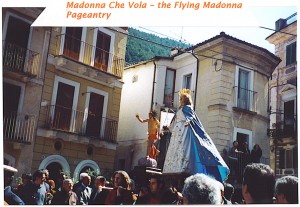
I believe the parade was led by the town band, for their funereal dirges could be heard echoing through the canyons of the 10th century town buildings. They were followed by elaborately robed mace and lamp bearers, who lit the way for the children, who, in turn, were said to carry instruments representing the pain suffered by Christ at his crucifixion. A small choir, in mournful and plaintive song, continued the cortege in a slow gait—a struscio—a shuffle of sorts, which represented the sorrow the world felt after the death of The Lord.

In the center of this corteggio, was a group of laymen who somberly carried two cloth-covered plinths, or catafalques: one bearing a statue representing the tortured body of Jesus Christ and the second, the Madonna, covered in black mourning clothes. Somewhere in their midst, a solemn priestly and prayerful voice rose above them.

Bringing up the rear were streams of silent, but tearful villagers—all women, all dressed in black—who sobbed quietly into handkerchiefs as they made their way through the narrow cobblestone streets, up and down the hills, through the town and back down into Santa Addolarota. It was here that each penitent filed before the illuminated statue of the Dead Christ, before flowing back out of the church and into a piazza.  Immediately, and before we could adjust to the change in atmosphere, the reverence for the Dead was broken with an explosive array of fireworks which bloomed into the darkened sky, then cascaded down onto the awaiting crowd of expectant and jubilant-faced children and adults.

We had skittered behind the crowd through the streets, had avoided using our cameras due to the reverential tone of the procession, then were hovering outside the church as cautionary observers when the fireworks began. Again, we looked around for our friend, Lucia. It was due to Lucia’s encouragement that we had made this trip in the first place. And, it was because of my interest in local traditions and foods that she suggested we join her here. You see, her ancestors hailed from this locale, so she knew many of the local people and had participated in a number of their local traditions which included this four-day festival. But, so far, she was still a no-show.

I was becoming a little nervous, as I had insisted we make this Mad-Hatters’ dash across Italy due to my unquenchable interest in traditional folklore, but my traveling companion, who has little interest in history, was only there for the food. So my hopes of having some explanation of the procession and its connection to the Christian and the pagan was still wanting and it looked like it would have to wait another day. Even though I could pick up on some of the light and jubilant expressions of people around me, I was literally in the dark. And reading Italian lips? It wasn’t happening.

We waited to see what was next on the list of festivities and I was praying that we would be introduced to some feste food, as food and festivals, I thought, go hand in hand. But as we began looking for a café or trattoria, we noticed that most people were carrying their transformed selves away from the piazza and home for a late and private repast. All stores were closed and no restaurants were open. We hurried quickly back to the car, as freezing temperatures were beginning to set in, and we hoped for the best at our heat-deprived hotel. It was there we found a roaring fire was filling the restaurant with warmth from the open pizza oven, and we were welcomed into the dining room for a most delicious dinner. Among the delightful courses we were served that evening was a pasta course, called Maccheroni alla Chitarra con Ragù d’Agnello e Peperoni. After I asked for a somewhat English translation about the pasta, my culinary frend perked up as she was familiar with the term ‘alla Chitarra.’

“Ah, ‘Guitar Pasta!” she exclaimed cheerfully for one of the first times that day. “This pasta is one of this region’s most celebrated pasta courses!” Aha! I thought to myself with a slight smile. This is her forte!

“This pasta,” she continued, “is made by using an instrument which resembles a guitar-like assemblage; a wooden frame with parallel strings.” Her arms flapped back and forth as she happily illustrated to me how squares of pasta dough were pressed through the strings of the ‘guitar’ with a rolling pin to form the thin strands of pasta. The waiters stood by smiling infectiously. The pasta was delectable and I found that night that the exuberance over food—in any language—can ease all qualms or fears I might hold about the unknown. That, along with the kindness of strangers. (Recipe follows, as will the next installments.)

Maccheroni all Chitarra con
Ragù d’Agnello e Peperoni
(Guitar Pasta in Lamb and Sweet Pepper Ragù)

This pasta is one of the region’s most celebrated pasta courses, and the pasta is made by using an instrument which resembles a guitar-like assemblage,
a wooden frame with parallel strings, which is used to cut the strands of pasta.

Lamb and Sweet Pepper Sauce:
1 lb. trimmed boneless lamb shoulder, in 1/8” chunks
2 T plus ½ teas. salt
¼ teas. freshly ground black pepper
½ C. extra-virgin olive oil
4 garlic cloves, chopped
3 bay leaves
1 C dry white wine (why not Trebbiano, from the region?)
4 plum tomatoes, peeled, seeded and diced (Dip in boiling water for a few seconds to
remove the skin.)
2 red bell peppers, cut into long, thin strips
2 yellow bell peppers, cut into long, thin strips
(Can be made three days ahead and refrigerated; reheat as you boil the maccheroni.)

In a medium bowl, toss the lamb with ½ teas. salt and pepper; cover and refrigerate for 2 to 24 hours. Next, heat olive oil in a 4-quart sauté pan over a medium to high flame. Add the garlic, bay leaves, and cook for 1 minute. Add the lamb and cook until browned all over, stirring often, about 10 minutes. Lower the heat and deglaze the pan with wine. When it evaporates after about 10 minutes, add the tomatoes and red and yellow peppers. Cover and simmer for 2 hours, stirring once in a while and adding a little water/wine if needed. Discard the bay leaves.

Meanwhile make the pasta dough and let it rest according to directions. Cut the dough into 4 pieces. Working with 1 piece at a time, keeping the others covered with a towel, roll out each piece on a lightly floured counter into a nearly transparent rectangle. Cut into rectangles of the same size as the stringed part of your ‘guitar’. Lay 1 rectangle over the strings and press down with the rolling pin to cut. These are your maccheroni all chitarra. Toss with flour, spread on a single layer on a floured tray, and again

Pasta Dough:
2 2/3 C. unbleached all-purpose flour, plus extra for counter
¼ teas. fine sea salt
4 extra-large eggs, at room temperature

Place the flour on a counter and add salt; combine with fork. Make a well in the center of the flour and begin to add the eggs one at a time into the well. Using a fork, draw the flour little by little into the eggs.

When almost all of the flour has been incorporated into the eggs, begin kneading the dough by hand; knead until it is smooth and firm – about five minutes, adding a little water if the dough is too dry.

Shape the dough into a ball, dust with flour, wrap in plastic and let rest at room temperature for 30 minutes. Then prepare to roll out. (Can be prepared 12 hours ahead of time, and then spread out on a floured tray and refrigerated, covered with a towel.)

Bring 6 quarts of water to a boil. Add the maccheroni and the remaining 2 tablespoons of salt and cook, al dente, or about 3 minutes. Drain, reserving ½ C. of the pasta cooking water. Toss the maccheroni with the ragù and the reserved cooking water in a bowl. Serve hot, passing plenty of Pecorino cheese at the table.

(Taken from Micol Negrin’s book, Rustico-Regional Italian Country Cooking. I met her at an IACP conference in Montreal later that same year as my trip to Abruzzo, Italy.) Snap Herplex Hub

Feste di Poderi di Montemerano, Tuscany, Italy

During our six-hour train ride from Milan, down through Genoa, and along the shimmering coastal waters of the Tyrrhenian Sea, my head bobbed on and off my husband’s shoulder. My thoughts kept the beat of the moving train—click-clack, click-clack—as I remembered with fondness how this trip to Italy had come about. It began when I found an ad for a rental listed in a San Francisco magazine: “Charming, Tuscan farmhouse, deep in the hills of Etruria.”

I recalled rolling the word Etruria off my tongue as I dialed the Bay area number in answer to the ad. I knew nothing about Italy, much less Tuscany, but the provocative sound of Etruria resonated through my mind. With very little fuss, my husband and I found ourselves seated in a small San Francisco coffee shop across a table from the owner of the ad and of the ‘charming Tuscan farmhouse’. Lisa appeared to be a quiet woman, was modest of dress with an unassuming manner, but she immediately surprised us when she boomed, “Do you want to visit Tuscany, or do you want to experience Tuscany?” Her blue eyes sparkled as her eyebrow arched to accentuate her point.

“My home is high in the hills of Etruria of southern Tuscany—in Poderi di Montemerano. This is where you will meet the real people.” Our souls lit up from the inside.

“When are you planning to go?” Lisa prodded us.

“We were thinking September would be lovely . . .” I started to answer.

“Ah, then,” she interrupted, “go the very first weekend. You can attend the Feste. It’s the harvest festival. You simply can’t miss it.”

As the train continued along its coastal route, my eye caught glimpses of snow on the mountain slopes north of Pisa. Surprised to see snow so early in September, my husband and I pressed our noses firmly against the glass for a better look. Then a rail yard blurred past us with palettes of white stone spread as far as the eye could see.

“Aha,” I said. “That’s not snow we’ve just seen. We’ve just seen patches of white marble—Carrera marble—the same marble Michelangelo made famous with his sculptures. We grinned at each other obviously glad that we had solved the mystery and that we had indeed packed enough warm attire. We settled back into our seats, but kept a watchful lookout for the Leaning Tower of Pisa. I must have drifted off to sleep when my husband murmured, “I think we missed it.”

“Missed the festival?” I mumbled out of my fog. “That’s not possible. She said we can’t miss it!”

“Who said you can’t miss it? What festival?” My husband looked confused.

“Lisa said, ‘you can’t miss it, because the festival will be right on our doorstep.’ Don’t you remember? Her arms were sweeping above her head and her voice was booming with such exuberance, ‘There will be traditional foods, music and dancing… All will be there for you to enjoy. I will come too, and show you around.’ That’s what she used as an inducement for us to come. Don’t you remember?”

“Oh, and the foods,” he drooled, “she told us the foods will be molto delizioso.” He rolled the words off his tongue as if he knew what he was saying.

“I can’t wait,” I said. ‘Only made in Poderi,’ she said, ‘and only made for the festival.’ Do you remember when she asked us if we liked Italian food? Don’t you remember how hard we laughed?”

“All she had to do was look at us! Why, we don’t miss a meal,” he shook his head with vigor. We settled back into our seats, with Cheshire cat grins swathing our faces. Yes, Lisa’s invitation was too seductive to resist?

“‘Come,’ she had said. ‘You will love it, and the festival will be a perfect introduction to Tuscany. You will revel in our beautiful hills, our delectable wines and sumptuous foods, but the people—they are the heart beat of Tuscany. Come!” And, so we came.

At Grosseto, a city halfway between Milano and Roma, a flood of relief swept over me as we stepped off the train and heard a familiar voice shouting, “Buòna sera!” and in English, “Good afternoon! Welcome to Tuscany!” Lisa, along with her dear friend, Cècilia, embraced us like we were long, lost friends then efficiently maneuvered us out of the station and into their waiting car. Within moments we, along with our bags, were stuffed inside the tiny vehicle and Lisa quickly headed out of the city traffic and into the golden Eturian hills. The sunlight fell in diffused webs over vineyards and olive orchards and dust lay lazily across rich, emboldened fruit, but we raced past.

Our excitement intensified as Lisa told us—again, with arms flapping in the air even though she was at the wheel—of the preparations going on in Poderi. “Today is the day of the Feste,” both she and Cècilia giggled like school girls. They had been helping with preparations all day and were excited to show us.

After an hour, she wheeled up a narrow road and parked in an open field under a banner which stated, Feste.

“There’s no room at the top,” she said, as if that was explanation enough. She helped us drag our bags out of the car and up a long hill to her house.

“I’m sure you are wondering where the village is, si? Well, Poderi,” Lisa said as a form of explanation, “is a 12th century feudal term which means farm. It refers to the land which was owned by the lords of the nearby castle of Montemerano.” She waved one empty hand to an out-of-sight hillside as she clutched a valise in the other.

“Only in the past 150 years have families been allowed landownership, so Poderi was never a town. It was simply a wide spot at the top of this hill where a cluster of farmhouses were built. My husband and I fell in love with the area and the people, so this is where we lived and raised our sons. You may meet one of my sons soon.”

By this point we had puffed up a very steep hill and paused to get our breath. We were sheltered by immense plane trees and surrounded by overgrown vineyards. I hoped we were near the top. But, now we could see across the open vistas Lisa had referred to and, on a promontory five kilometers in the distance and perched in the sunlight, was the silhouette of a medieval walled city with a square keep from a castle towering above all.

“That’s Montemerano. And, just beyond Montemerano,” said Lisa pointing to hills just beyond, “is the ancient termé of Saturnia. I’ll take you to the Roman baths there. It’s quite relaxing. . .”

Before she could continue, we heard a multitude of voices rise in a cheer, and we turned to round the final curve and there before us was a raucous crowd filling the street. We inched slowly forward, dragging our bags across the stone road, past a band shell and came to a stop in the heart of the throng. Jubilant faces foisted themselves into ours. Kisses smothered Lisa, Cècilia, and now us! The cacophony of Italian voices grew and I could barely hear myself think. Lisa was pointing up. Over our heads, I could almost make out a string of buildings on either side of the road—some with honey-colored stone façades and others, white stucco. Various styles of wooden shutters had been flung open as children along with hovering mothers hung out of the second-story windows, laughing and shouting to the crowd below. Fuchsia-colored roses cascaded past their noses and along the outside of the structures to brush against the entry doors. And as we stood in the throng trying to figure out what was being said to us, Lisa turned to us and pointed again at one doorway. Over the din, she said simply, “In the States we would call these condos; here we call them farmhouses. You are almost home.”

“And, see,” she said, “the festival—it is right on your doorstep.” She laughed heartily as surprise registered on our faces.

She strode through the crowd, embracing one person, then another, kissing this person and then another, before leading us into her home. Many hands helped us drag our bags in the door and up the stairs to the living quarters above. The lower quarters, she told us, had been relegated to storage—after the farm animals no longer had residency.

While contemplating the concept, we began to look around. The living room was open and spacious. Hewn timbers crisscrossed the high ceilings, and a coat of white paint covered all the walls. Near the center of the room was a dining table splashed with a yellow Provençe-style table cloth. Four chairs with red print seat cushions sidled up beside. On the far wall was a stone fireplace which had served as the only source of heat for over one hundred years. Two roomy bedrooms were tucked behind the wall of the fireplace, with windows which opened onto vineyards, farms and across the way, to the village of Manciano. The bathroom was compact, but convenient and the kitchen was roomy with voices floating in the open window from the people in the street below.

After our quick tour through her house, Lisa quipped, “The Feste will start in an hour, so rest up, as it lasts until tomorrow.” She prepared to slip back out of the house and into the street where her friends awaited her when we asked, “Aren’t you staying here with us?”

“Heavens, no! This is your time. And your place for now. If you need me, I’ll be staying across the street with my friend, dear Margarita,” and she was gone.

Before we could even unpack, we collapsed on the bed, hot and sticky from our day’s journey, too tired to move. We dozed off, but were slightly aware of a low, mournful, almost Arabic-sounding chant that echoed up the stairs from the street below. The voices were first sonorous, deliberate and lyrical then ended abruptly with great laughter and applause. Then, another vocal utterance would take up in response, and would continue with a vibrant beat. Not a word could we understand. I was not certain if these mournful poems were part of my sweat-soaked dreams or the reality of—where was I? My husband forced me into wakefulness, as we crawled off the bed, along the floor in order to peek out of the kitchen window.

Directly below us, a multitude of faces focused intently on our doorstep which, by now, had been transformed into another stage. A contest of sorts was being held; indeed, a poetical sparring, known as a Tuscan Contrasto. Lisa later explained that the audience provided each team a spur-of-the-moment theme of contrasts, and in eight-meter improvised rhyme, the men hurled their words like lances at each other. This event, which had been performed since medieval times, signaled the beginning of the Feste di Poderi di Montemerano. We were just in time.

Pushing through a thick gauze of sleepiness, we quickly sponged off, changed clothes and headed down the stairs. As we stepped into the street, Lisa met us and began to introduce us to her many friends. This one was from Switzerland, that one from Sweden; this one from Germany, and that one from—of course, Poderi. We immediately felt included for they were as warm and welcoming as she had promised. And, fortunately for us, all but those from Poderi spoke English.

Then, like lava flowing down a mountain, the crowd began to ebb along the stone roadway with us caught up in the current. All were moving toward the festival grounds at the bottom of the hill. Smoke from the pits of braising meats tantalized us, along with the intoxicating aromas of simmering pasta sauces. The crowd turned toward the ticket booths as the excitement grew. Music, laughter and the banter of their melodious language filled the air. Because we understood very little Italian, Lisa recited the menu in English in the most delectable detail. We hungrily placed our orders.

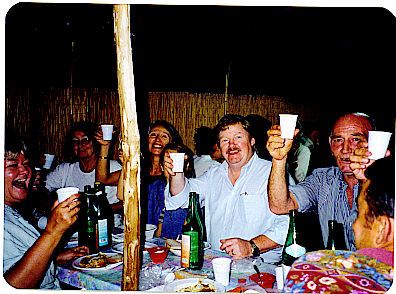
Another push from the crowd propelled us into the nearby tents, where we were once again greeted with hugs and kisses by those who were already glowing with amiability—and wine. Lisa wedged us into the two remaining seats beside her in the middle of a long table filled with twenty or more of her closest friends. We had barely been seated when a trumpet sounded and the feast began.

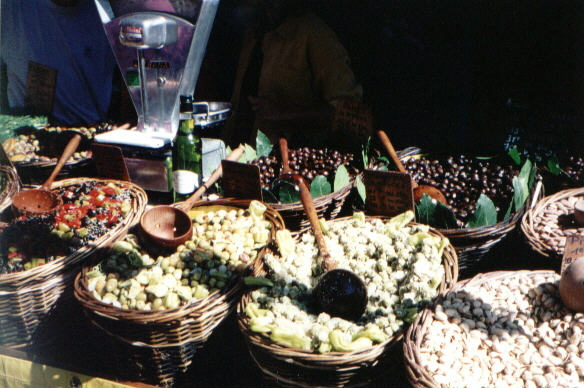
The doors to the kitchen were flung open and local waiters proceeded in great numbers to the tables with plates of bruschetta, toasted bread covered with rich, local olive oil, chopped fresh tomatoes and succulent olives. Bottle after bottle of homemade wine began to magically appear—some from the kitchen, some from under the table. Again, the waiters swung out of the kitchen. For the prima piatti, or first course, platters of fresh pasta were served. Plates of tortoni, Poderi’s specialty pasta—delicate pillows filled with cheese and arugula—were reverentially placed before us covered with a bubbling, robust marinara sauce. The masses swooned with appreciation.

Lisa leaned over to us and whispered, “I had to live here over twenty years before the older women of Poderi allowed me into the kitchen to help prepare their beloved tortoni. And, the recipe? Don’t even ask! It is still a much guarded secret.” She laughed with bravado.

Sweet, yet quiet Cècilia leaned over the table and said, “They’d perhaps have to keel you!” She grinned and sat back as hand-made gnocchi with meat sauce and pasta e fagioli were whisked to their designated places along with baskets of Tuscan bread to sop up lingering juices.
For our secondo piatti, or second course, sizzling grilled meats of beefsteak, pork, chicken or sausages-on-spears were passed down the tables. Then, contorni, or vegetable side dishes, of white beans, fried potatoes or mixed green salads, followed the meats. Gasp!

Filled to the brim, we all leaned back to gather our collective breath, but to no avail. Next, we were being tempted with the formaggio, or cheese course. And then, another highlight of the evening, the dolci, which was presented with a final flourish. Lisa told us we were to choose from either Mousse di ricotta, which was a sweet, creamy custard made by Lisa’s neighbor Margarita who sat across from us at the table and was mouthing a few words. I could not make out her words over the noise.
I turned to Lisa for an explanation and she said, “Margarita used 72 eggs! 72 eggs to make the Mousse di ricotta! Can you imagine that?”

And, then we were given another option. A salame, which was not a sausage at all, but a rolled cookie filled with chocolate cream. This was prepared by dear Amelia who waved to us at from the end of the table. Of course, we tried a little of each; we had too. Each was delicate, light and sumptuous! Wine continued to be poured throughout the meal, and when one bottle was emptied, another would appear.

As the evening flowed into night, the air filled with music from a local band in the piazza back at the top of the hill. The rhythm reverberated throughout the tents, and the crowd once again was on the move. Following a festoon of colorful lanterns, people of all ages made their way to the top of the hill. Wizened old women in their best black dresses, shiny from use and a heavy iron; short, rotund old men in their best suits, a bit rumpled from the lengthy dinner; young couples in sensually-loose clothing looped together like knots in a tie; giggling children in shorts and tee-shirts, now grabbing up sweaters handed to them by caring parents; swaddled babies snuggled down in the arms of protective grandmothers; and the likes of us, middle-aged folks laughing at shared stories enjoying another paper cup of wine—all climbed the hill to the beat of the music.

At the moment of reaching the top, the harvest moon broke out above the rooftops and sent golden light cascading onto the heads of the villagers below. In spite of—or because of—being thick with food, wine and the beauty of the night, everyone began to dance. The music was a captivating mix of old and new, some rock and roll, some lilting Italian melodies, and even some familiar American pop tunes. But, when the waltzes began, my husband and I stood back to marvel at the grace and elegance of the more skillful dancers. We love to dance but we were not worthy.

“Watch for dear Mondiale,” Lisa shouted to us, “for he is the most exquisite dancer of them all.” And there he was: the burly town butcher from Manciano, just a hillside away, guiding and gliding his partner with finesse and grace across the ancient stone street beside us.

“You are, indeed, a lucky woman to be able to dance with Mondiale,” Lisa whispered to us, as he wrapped his arms about her and whirled her away.

As night became morning, the townspeople, undaunted by the late hour and copious amounts of wine, continued to dance. We were no match for these stalwart sorts, so we crept back up the stairs to our newfound home. With exhaustion cleaving to every part of our beings, we pushed open the bedroom windows for just one last look. The moon spilled into the room and across the bed filling it with light. It flowed like mercury over the ancient hills and valleys beyond us. And, there silhouetted against the night sky, was the medieval fortress and clock tower shimmering on the highest hill in Manciano. Awash with exhaustion but gratitude for having experienced the beauty of both people and place, we slid into bed. Our eyes flickered closed as the final songs reverberated from the streets below—or was that the heart beat of Tuscany we were hearing? Snap Herplex Hub

A Drama Unfolds in Salerno

We thought of ourselves as worldly. And I suppose for Swedish Methodists plunked down on the Nebraska plains we were, because early on we had been introduced to the world of international cuisine on our very doorstep.

It was through Old Gilberto. He would drive through our neighborhoods with a clunk, a clank, a rattle and a roar as his truck lurched along our partially paved streets. And his morning cry would resound above the clatter of his truck with his rich Italian dialect (that’s Eye-talian, for the uninitiated). He would offer to sell to all the housewives in our small town the delicacies of ‘slightly bruised’ cans of corn, peas, beans, succotash and, of course, our favorite which came in a ‘most superior’ yellow and brown tin by Franco-American. “Spaghetti and mothballs,” he would cry out. “Spaghetti and mothballs. Come get-ta you family fa-vo-rite! Six balls in every can.” We would giggle with glee.

On rare occasions—like when our Mom was in the hospital giving birth to one of my many younger brothers—my father would treat my older sister and me to a sit-down dinner in our local Greek restaurant. One time I actually ordered a real plate of spaghetti, and someone near me taught me how to ‘twirl’ my spaghetti strands with my fork onto my spoon. I remember then that my mind soared with dreams of international travel.

As a young teen, Sunday night for our family was pizza night. My sister would break out a box of Chef Boyardee’s pizza mix and create an extravaganza that only we could appreciate, for in that small mid-western town there were no pizza places and, therefore, no pizza delivery. She adeptly beat at the dough, let it rise, spread it on a cookie sheet, sprinkled a pound of raw hamburger across the top, and covered it with the package of dry yellow powder mix we assumed was cheddar cheese. She then popped it into the oven, and we called her ‘our gourmet.’ Funny thing is, a few years later when she got married, that was all she knew how to prepare.

Stepping forward in time—oh, maybe forty years or so—I found myself realizing my dream while on a traditional foods tour in the City of Salerno, in Compania, Italy along the Amalfi Coast. The goal of the tour, provided by ‘Oldways Preservation Trust,’ was to introduce food writers, cookbook authors, chefs, restaurant owners, early Slow Food Members, nutritionists and the rest of our ilk from around the world the traditional, regional foods of the region of Compania.
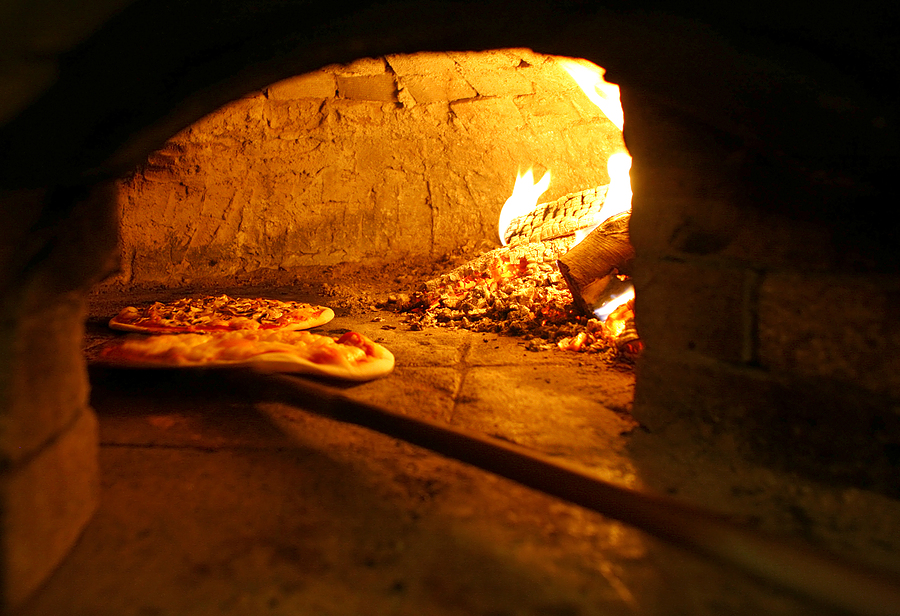
At this point in our tour, our guide and translator, a lovely American gal married to a Neapolitan, was on-stage in the hotel lounge busily teaching our group of one hundred or so—along with some dubious-looking, black, leather-jacketed interlopers—the original recipe for pizza.

Pizza Margherita in Brick Oven

Pizza Margherita in Brick Oven

“Just up the road is the City of Naples,” she said, “and it is considered to be the home of the first pizzas ever made. Since the 1830s, Neapolitans could tell you, there are only two true pizzas—the ‘Marinara’ which is the oldest and is made with a topping of tomato, oregano, garlic, basil and extra-virgin olive oil. (No seafood, in spite of the name.) And, ‘Pizza Margherita.’ This pizza was named after the Queen of Savoy in 1889 after she sampled this simple but elegant pizza made with fresh (green) basil, (white) mozzarella cheese and ripe (red) tomatoes—the same colors of the Italian flag. Only a true Neapolitan pizza,” her chin rose with the telling, “can be made with ingredients that come from this area—San Marzano tomatoes grown on the slopes of Mt. Vesuvius, fresh basil grown locally and olive oils which come from the vineyards that reach into Naples herself.”

While she was busy talking, a portly blonde, blue-eyed, red-faced man pulled on a chef’s jacket and popped on his toque, before walking onto the stage. In the background and close to the back doors, we could see large dome-shaped, portable wood-fired pizza ovens. Bundles of faggots were bringing the ovens up to the required heat. 485 degrees C. Cooking assistants appeared and began setting up the demo table with glossy rounds of pre-made dough, along with bowls of chopped garlic, fresh basil, oregano, thinly sliced tomatoes—San Marzano, I presume—slices of fresh regional buffalo mozzarella cheese, along with a plethora of tall, green bottles of local olive oils which stood like soldiers, as if at attention.

Then the chef began his demonstration of the culinary process. Our guide busily translated his every word. Step by step he moved, like a well-choreographed dancer. He pummeled, rolled, then shaped the dough with his fingers and hands only. No machines or rolling pins allowed. No-no-no! He slapped the pizza dough down on the counter, and then spread it thin. He reached for the sliced tomatoes and with a flick of his wrist fanned them clockwise like a deck of cards onto the surface. With a splash of olive oil and a sprinkle of herbs, he then laid out the buffalo mozzarella cheese, before following with a delicate touch of fresh basil. Just off-stage the savory aroma of fresh tomatoes, cheese and herbs was beginning to waft in our direction along with the acrid odor of slightly burned crust. Our appetites were whetted. We were ravenous.

The crowd oohed and aahed reverentially in all the appropriate places as we slurped down a—yes, a local regional wine. An enthusiastic few leaned forward to catch each and every nuance of the aforementioned techniques, writing notes in a furtive frenzy. Somewhere in the midst of vast trays lined with steaming hot wedges of pizza being circulated through the horde, I became aware of a slight lull in our translator’s voice. She came to an abrupt stop. She turned to the chef beside her, her eyes wide open with alarm. A murmuring began to stir the crowd; voices began to lift; then shouts in thick Neapolitan split the air. The burly, black leather jacketed interlopers suddenly were moving toward the stage. A chair was lifted high as if to be brandished.

“What is happening?” we whispered to each other. “What is going on?”

The bartender, safely ensconced behind the bar, leaned over to us and in a gruff repartee, began to explain. “It’s like this. The chef—it appears he’s from the North,” he gestured to the ceiling. “He has the audacity to come down here to the South and explain our birth right? Pizza?” He sneered again. I guessed that wasn’t a question he was posing.

Quickly the on-stage chef exited along with his Northern-Italian counterparts. Pizza ovens were slammed shut with pizzas still baking over hot coals, as the crew squealed out of the parking lot. The room emptied; the voices dropped and I licked the essence of the one small sliver of pizza I had sampled from my finger tips.

“Well, I’ve always wanted to go somewhere dramatic,” I said, grinning at my compatriots. “But until now, I had no idea who put the ‘drama’ into Italian food. All this time I thought it was Gilberto!”

“Another round?” asked the bartender. Snap Herplex Hub

Medieval Cuisine in Arles, France

Les Cailles à Hydringus et Zinziberine
(Quail with Hydringus root and Fresh ginger)
Carole Bumpus

“We are now ready to fully engage in the serious business of ancient and medieval cuisine,” Madeleine Vedel began. Our Provençal culinary tour group huddled around Madeleine and her chef husband, Erick, as she translated his every move. We were standing in their kitchen, which was purported to have once been a first century, A.D., Roman stable.
“Arles is situated on the Rhône River and is one of the first ports-of-call on the inland ‘highway’ into France from the Mediterranean.” We all nodded our heads vigorously, put down our wine glasses and took up our pens.
“Long before France was named Gaul by the Romans,” she continued in hushed tones, “commerce flowed through our ancient city. You see, food and recipes have always transcended the need for a common language and as mariners stopped at our port, they shared recipes and spices from their homelands. Tonight you will experience some of these ancient recipes.” My heart skipped a beat and I began writing with a frenzy.
“Our first recipe is called ‘Paquets d’Aubergine, or Eggplant Packets; the second is Le Tian Provençal, a mélange of succulent summer vegetables. But the third recipe is most unique. It’s called Les Cailles à’Hydringus et Zinziberine,” she purred, drawing the words out dramatically. We nodded our heads appreciatively, having no earthly idea what she had just said.
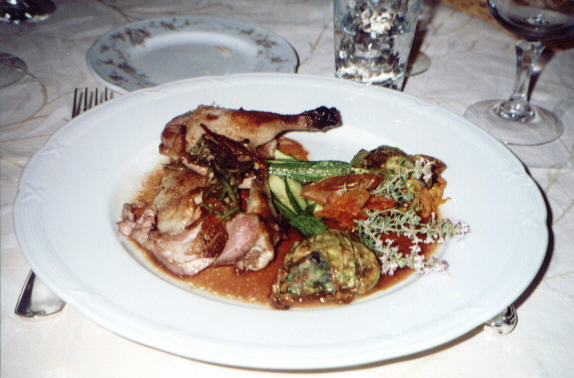
“Ah, this is quail with hydringus root and fresh ginger. The recipe uses the medieval method of double-cooking meat and game twice. First, the quail is poached in broth and then, deep-fried in lard. The little birds are then served with a relish, or confiture, first noted by Nostradamus in the 16th century. He lived only a few short miles from us in St. Remy,” she said in an off-hand sort of way. “His sauce is an example of sweet and spicy flavors blended together.”
“Zinziberine,” she continued, “is the medieval word for ginger while Hydringus is the medieval name given to a rare root vegetable known in Provençe as ‘panicaut’. I believe it is from the artichoke family, but Erick chooses to use carrots instead.” We all looked up in surprise as she casually shrugged her shoulders. “The flavors work well and the produce is readily available.” It worked for us.
During the following steamy hours of observation, my imagination took wing. I could envision those boatmen from a millennium ago and the entire seamy, yet savory scene: olive-skinned men wearing filthy blousons and pantaloons with brightly-colored scarves wrapped about dark heads; sweat-soaked faces working over a steaming cauldron while a concertina played and men laughed raucously around a roaring fire. And, I swear I could hear the sound of knives whacking at meats and vegetables, while greasy hands sprinkled exotic spices over the finished product. I was enchanted.
Finally, it was our turn to cook. I chose to work on the Cailles. I began by wrapping my hands around those lovely little quail just to experience what others had done before me. I ignored the titters of laughter and the lively banter around me and concentrated on the task at hand. Swiping at a flopping tendril, I leaned my sweat-soaked face over the simmering broth and dropped in the featherless carcass. Scooping it out of the broth, I dried the drooping creatures, quickly dusted them with corn starch and immersed them into boiling oil. Voilà! I had found my new passion: preparing recipes from ages past.
When our cooking lessons were complete, dinner was served. Succulent aromas of olive-oil laced vegetables filled the air, as cheese-encrusted tians of Aubergine Paquets sizzled in our midst. Then, the pièce de résistance, Les Cailles à l’Hyringus et Zinziberine, was placed in the center of the table. There, staring up at us were fifteen pairs of eyes from the displayed—or splayed—golden-brown bodies of the quail. Some of my cohorts withdrew from the prospect of eating the ‘little birds,’ but I found the quail quite delectable. All were consumed, including the crunchy little heads. And, why not? Where else could we experience delicious and sumptuous recipes shared from hundreds of years ago? Ah, and just a touch more Provençal rosé from the Côte de Rhône, s’il vous plaît.

Tour conducted at the home of: Erick and Madeleine Vedel
of the Association et Cuisine et Tradition
Arles, France
May 1st, 2000 Snap Herplex Hub

« Older posts Newer posts »

© 2026 Carole Bumpus

Theme by Anders NorenUp ↑